A Few Days Later…

A couple of days have passed since I finished my Senior Project at Tri-State Bird Rescue and Research and things are finally starting to get back to normal. “Normal” is kind of a strange word though because it wasn’t long ago that taking care of sick and injured birds for eight hours a day was normal for me. Well, regardless of what is and isn’t normal, my Senior Project is done and Spring Break is slowly coming to a close. It’s nearly time for me to return to Westtown and share my experience with both my peers and teachers, but the problem is I am not entirely sure how to do that.

I could share my experience in the sugarcoated version, which would be that each day I had a pleasant 50 minute drive down I-95 in the morning and taking care of the birds was a piece of cake. That wouldn’t be the truth though. The truth is that I had a horrible 50 minute drive each morning with cars going 25 mph over the speed limit zipping by me and nearly crashing into me. The truth is that in order to prevent the birds food I had to cut open mice with pairs of scissors and inject them with meds. The truth is that every couple of days a bird would poop on me and it would stain my sweatshirt and make me smell for the rest of the day. I think when I tell my friends at school (at least the ones who aren’t reading this right now) I’ll tell my story somewhere between the two versions.

No matter how I let everyone know about Tri-State, I will never be able to put into words how grateful I am for the experience to volunteer for the past two weeks. Working with the birds has confirmed my suspicion that I would like to work with animals for a career, but I am not sure in exactly what form yet. I guess that’s what college is for! Anyways, I think I will finish my blog with the same picture I used to start it. Here is a photo of Tri-State Bird Rescue and Research located in Newark, Delaware. Hopefully this won’t be the last time I volunteer and help the birds recover! To all of my readers, thank you so much for sticking with me for the past couple of weeks and being a part of my experience. Once again, thank you and goodbye!

P.S. If you have the chance or live close to Newark, please check out Tri-State because the work they do is incredible and all donations are appreciated!


Creative Writing Away From Home

So today I showed a family member some of what I’ve accomplished over the last few weeks. As I mentioned in my last post, I’ve always been a little apprehensive about showing people – even family members or close friends – my work, and this time was no different. I sat on the couch while she read it (a poem),  fiddling anxiously with a loose thread trailing from one of the cushions. I studied her face, trying to interpret her expressions. Would she like it? Was it even any good? Was I a good writer?

I guess these are some of the questions that lurk at the back of the mind of every writer.  For me, at least, my writing is always inextricably linked to me as a person – criticism can sometimes feel like a personal dig. It’s jarring to think that a piece of work that is important to you, that you’ve worked tirelessly on night after night, week after week, could be harshly criticized or even completely dismissed by someone.

In this case, my family member actually did end up liking the poem I’d showed her. She had a few criticisms, or “personal preferences,” as she called them – pointing out a line she thought had an excessive amount of adjectives, for one, or suggesting I clarify an obscure reference – but ultimately her reaction was positive.

These last few weeks have been alternately frustrating and illuminating. It was hard to jump back into writing at first – writing for myself, that is, not for any class or scholarship contest or club commitment – and I suffered from a bad bout of writer’s block for the first few days back home. But this time has also allowed me to articulate my thoughts and feelings regarding writing in a much more concrete way. I can now speak to the fact that I love that poetry, as a medium, relies just as much on the sound of its words and phrases and how they link together as it does its substance. I love that writing short scenes – vignettes- allows you to capture a range of emotions in what is essentially a quick snapshot of your life. Writing is, and will be, always an integral part of who I am, and I’m happy I got the chance to do something that I’m truly passionate about during my senior project.

Life in the Desert… the Future of Israel?

I spent this week in the Negev Desert at Sder Boker.  This is where Ben Gurion (the founder and first Prime Minister of Israel) spent the last few decades of his life.  He believed the future in Israel was in the desert.  I stayed at the Zuckerberg Institute for Water Research, a graduate school of Ben-Gurion University.  I learned about the amazing agriculture technology, desalinization processes, and necessary water technology to live in a dry climate. During my trip, I traveled to Masada and the Dead Sea and spent some time with the Westtown group!  They are currently on their flight back to the US, but they had a very powerful trip.  I really enjoyed my time in the desert, it was breathtakingly beautiful.

I hope you enjoy these pictures and they give you a sense of the vastness of the Negev!


Much love,

Hannah

The Musical Connection

I’m continuously astounded by how much music there is in this city. It’s impossible to walk out into the streets without hearing something. There’s bands playing on rooftop restaurants, restaurant patios, pop up venues in parking lots, and in the streets. It’s really incredible to be surrounded by so much live music. This trip has been really eye opening to me because it has solidified the idea that music is the only thing that can connect people so deeply and viscerally. People have come from all over the world to Austin for a week of music and I find that really incredible. Nobody cares what the artists look like or where they’re from, it’s all about the art they’re creating. If the music is good, everyone is happy and if it’s not so good, people just move onto the next venue.

IMG_9588.JPG
Something that really highlighted this for me happened last night. I went to a showcase to see a girl called CLOVES perform and after she finished her set I started talking to her. She lives in England and most of the people who write for WTGR also live in England. I mentioned to her that I write for WTGR and we’ve covered her a few times she immediately brightened and said, “Oh yeah I know Matthew, he’s wonderful!” Matthew is another writer for the blog and he lives in Cambridge and I thought it was so cool that the three of us were all connected by music, despite never meeting in person before.

She was one of the many incredible acts I was able to see yesterday. I went to a daytime IMG_9574.JPG
party where I saw Declan McKenna, a 17 year old guy from England, and he was so impressive. It was just him, his guitar, a keyboard, and a vocal looper on the stage and he was able to create a fully fleshed out sound all by himself. I also saw KLOE from Scotland and her set was very nice too. In the nighttime I saw Roo Panes in the same church I saw Clara-Nova and he was absolutely incredible. It was a very intimate show with just him, his guitar, and an audience of maybe 20 people. Later I saw KYTES, a four-piece band from Munich that makes upbeat indie pop, and The Young Wild, a Californian band that draws influence from their sunny state. I’m sad that there’s only two days left of SXSW, but I’m so glad that I’ve had this experience.

-Amanda

What I Will Take Away From Tri-State

Vulture plate. 6-10 pieces of chopped up chicken breast, 6-10 pieces of old fish (any will suffice), one quarter cup of soaked dog kibble, 1-2 egg yolks, and 1/2 tablespoon VitaHawk sprinkled on top. Songbird platter. A layer of dog kibble topped off with a couple spoonfuls of crushed grapes sprinkled with a little bit of egg yolk. If nothing else, I will take away these recipes, which have been ingrained in my head, from my time volunteering at Tri-State. The only problem is that there is a 99% chance I will never have to make them again after tomorrow.

It’s strange to think that tomorrow is the final day I will have to wake up at 6:45 and make the 45 minute drive down to Newark, Delaware. It’s the last time that I will be putting out bird feeders with the bitter wind biting my fingers early in the morning. It’s the last time that I will be preparing food stuffed with meds for birds in need. It’s the last time that I will be sweeping floors and cleaning dishes, that is, of course, assuming I don’t get wash for my next work job rotation!

Most of all though, I am going to miss working with the other volunteers to quickly come up with a strategy for cleaning a cage while a bird is temporarily being inspected by the veterinarian. While the cleaning is stressful in the moment because of the time constraint, there is something especially satisfying afterwards when we can all come together and laugh about how we somehow managed to defy the odds. The bird that I am specifically thinking of is a 4th year Bald Eagle, which is pictured below. What’s different about a 4th year from the common adult eagles you guys probably think of is that a 4th year eagle has a dark grey/white head because it hasn’t fully matured, which is indicated by the color of the eagle’s head. The traditional adult eagles, which all of you probably think of, have completely white heads. Here is a picture of a 4th year Bald Eagle.

Hope for the Telescope

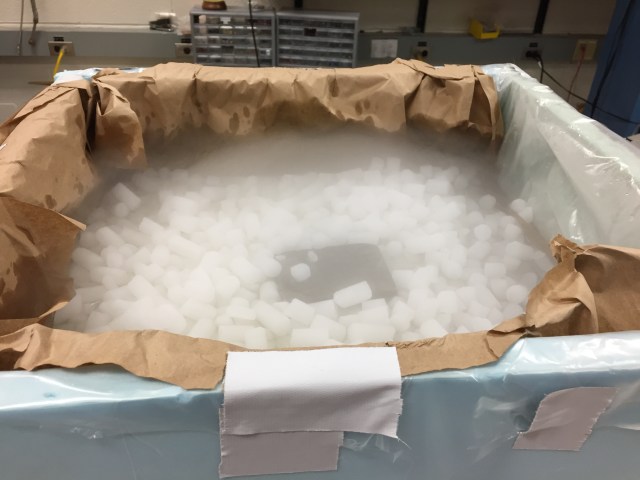
Last Friday was my last day in the lab, and over the past week I’ve been thinking a lot about the experience I had and what it means for me going forwards. The last day I spent in the lab was similar to Thursday. Simon and I worked on a second cold load to measure the detector response using alcohol, liquid nitrogen, and dry ice.

IMG_0314

I was able to run the program to start the detector response curve this time, and I could see the graph move as Simon slid the lid under the box. As we looked at the graphs, Simon and I talked about the future of the project.

“Will you still get a picture, even if it’s running .1 milliKelvin over what you were expecting?”I asked.

“We’ll definitely get a picture.” said Simon. “It’s just a matter of how detailed it is. Keep in mind, this is the one of the highest resolution telescopes of this kind that’s ever been made. We’ll still get to see the skies. And it’s looking good for the telescope. We know what’s wrong, and hopefully by opening up the cryostat, we’ll be able to fix it. It will set us back by a few days, but we think we can fix the temperature. There is hope for this telescope to work the way we wanted!”

This was good news for me. I couldn’t even imagine the frustration I would feel if I had worked on such an expensive and difficult project for so long just for it to fail. But the hope Simon was feeling and the determination he had to make the project made me confident they would find a way to fix their problem.

After spending a week in a lab, I have a better idea of what it means to be an astrophysics. Sara described that there’s a lot of small-scale work and programming work to get to the big stuff (looking at the galaxies). This was something I never thought of, and it’s a good thing to know going forwards if I want to do this kind of work. Sara also said there’s a more theoretical side to astrophysics, one where theories are developed and ideas are thought up. It seems that it’s possible to do a multitude of things in this field. Although sometimes working in the lab was difficult and tedious, with lots of tests being run and lots of data to sift through, I can only imagine what it leads to. Doing the tedious work is worth it to look up into the sky and through time to the beginning of our universe. Spending a few weeks, a few months, a few years working on a telescope may seem boring, but it’s worth it to look up at the stars and to start to understand how we got here.

Internet woes

Our signal is very slow here and we have opted to upload our blog even though we can’t get the photos to load. When we have a stronger signal/higher speed internet we will add photos! So stay tuned!

Day 13 March 16, 2016

Today began with a well-planned, well executed, carination of one Dahoon Jose Juan Song. Hoon received a guitar-accompanied performance of both the Spanish and English “happy birthday” songs, while I sat on his bed getting his dogs under control. The day was off to a great start. After walking back to the “big house” after finishing our morning duties, we made a nice buffet style yogurt, granola, fruit, and bread station, which made for quite the breakfast.

After breakfast we prepared to go and visit our new rural school friends, this time at their place of business. After a short hike to Anja and Alex’s house to borrow a car, we were on our way to the school and Huatusco. We reached the school and were warmly greeted by “the homies”.  A couple handshakes and tapas later, Mekhi, Dahoon and I found ourselves in the middle of a friendly fùtbol match. Mekhi came out on fire, scoring the first two goals of the match. After some mild to lackluster defense from our female teammates, we were facing a surely insurmountable deficit. Dahoon and I did our best to get back in the game via him serving me up a few lobs, which quickly turned into screaming volleys as they hit my foot. Although the non-present scoreboard showed the other team having more goals, our team surely triumphed by means of spirituality and sportsmanship.

Following the game, we were kindly toured by two teachers and many students who showed us their progressing advancement in Eco-technologies such as compost piles, designated plastic disposing areas, a small garden with hanging orchids, and their compost packaging partnership with an urban school in which they provide the compost and in return get it packaged while retaining 50% of the profit of the sold compost bags. After the tour, we were able to share our thoughts, show our respect and appreciation, and acknowledge our possible role as creating a brother/sister school relationship with Westtown to help with the money issues, among other things, that go into converting a school such as that one into a completely eco friendly environment. It should be noted that this school in particular is hoping to be the benchmark for sustainability; if/when successful, they will be the model for all of its 1,200 peer schools – the effect of this accomplishment is obvious.

After the presentation and our reflections, we were directed to meet with the students at their main building for a surprise. Once gathered, the students brought out a birthday cake for Dahoon as we all sang to him. The cake was as sweet as saying adios to our Mexican friends was bitter. After a bite of cake, hugs, and many pictures, we were on our way to Hoon’s birthday lunch in Huatusco, where Guillermina was anticipating our arrival. After noodles, optional chicken, eggs, plantains, soup, and another birthday cake, we were ready to call it quits. We said goodbye and thank you to Guillermina and began walking to the urban school, where we were planning to see another group of students that we had taught and exchanged contact info with the day before.

Once in the school we sat and spoke with the assistant principal, talking briefly about what we showed the kids and a more general synopsis of the work Alan and Paula are doing in Las Bellotas (the conversation was in Spanish so don’t quote me on what was said). We were given a quick tour, and to our disappointment had to leave before seeing the kids we met yesterday. Sentimentality aside, we were back on the streets of Huatusco where we had a few minutes to shop. We then met in Hector and Pati’s yoga studio, and a few minutes later were on our way home. We made it back exhausted but in good spirits.

After a good while of resting, afternoon chores, and general chilling, we went and visited our old compost piles we made what feels like a month ago. They weren’t hot like expected, but that didn’t matter because we were now focused on meeting yet again with our apprentice friends for games and dinner. Once there we had a great meal accompanied by fun table games that are too numerous and complicated to write about at the moment. After cleaning up and saying goodbye, we were on our way home, where we are now; showering, taping up blisters, eating leftover cake, sleeping, talking, and blogging. The day was busy with memories for all of us, but for only Dahoon will these memories turn into that of legend. What a (birth)day. I’m hoping to fall asleep soon, in search of much needed rest to lead yoga tomorrow, which with luck, will be followed by ziplining, which will then be followed by our night of camping under the stars… We are all crossing our fingers for clear skies tomorrow night.

See you soon, Samuél
Day 12 Tuesday March 15

Today was doomsday, but it went really well! For the past week and a half, Sam, Dahoon, Mekhi, Teacher Alan, Teacher Paula, and I have been preparing for a visit from two Mexican schools. We planned to teach the students twenty different Eco-technologies that they could implement in their own lives to improve their personal sustainability, home efficiency and overall impact on the Earth. To prepare, we have had many practices in both Spanish and English and I suspect far more stress and nerves than any of us are willing to admit. Yet, no matter how ready we were, today the students arrived! This is what happened:

We woke up at seven as usual for yoga and a quick breakfast of eggs, beans, and granola. At 9:00 the first group of nineteen kids and their teachers arrived from a rural school outside Huatusco. After introductions and a great presentation on climate change from Teacher Paula, I led the group in a game of elbow tag. Afterwards, we broke into small groups with or without translators and led our new friends to four different Eco-technology stations. I started with the dam, water pump, and bamboo bridge, then moved through the efficient ovens and stoves, lights, solar panels, water filtration systems, cooler, ecological toilets, and compost, also stopping to discuss firewood, mushroom farming, gardens, food forests, and tire staircases. I particularly enjoyed talking to Eugenio, an awesome student who helped me with Spanish grammar and took a large interest in sustainability. After our tour, we reunited with the others on the main porch to share what we had learned. Our Mexican friends brought us wonderful homemade snacks and also shared the process behind their school’s recycling system. We circled up on the lawn for a Big Sit and Yurt Circle and took many photos together before waving goodbye our new friends. After a quick lunch, debrief, and imaginary nap, it was time for round two!

The second group of students was much larger, with twenty-nine students from an urban Huatusco school. These students were much more lively, distractible, and outgoing, though they too seemed to enjoy learning about our ecological systems. Overall, both groups were excellent, and learned a lot about Eco-technologies while teaching us about their own systems at home. After running through the activities a second time, we were all mostly exhausted, though we did have enough energy to take even more photos and walk our friends down to their pickups. They tried to convince us to come back with them to Huatusco, but unfortunately we had to decline. Heading back to the house, it felt like we had made an actual connection with other kids as well as finally mastering the information we had been so stressed about. Back at the house, we took time to stare tiredly into space, eat food, and finish our chores, and then went over the river to herd the sheep.

On the way to meet the apprentices, we met Oscar, our fifteen-year-old shepherd friend. We talked to him for a while about his life in Las Cañadas and taught him some English phrases, before starting a baseball game with a dog and some rocks. We herded the sheep, caught up with our apprentice friends, and then returned to eat dinner and practice our songs. It turns out that both of the injured lambs died in the past few days, a fact that made me extremely sad. I hope that the rest of the lambs live on into the future.

After dinner it was time to celebrate Dahoon’s birthday! Even though it is his birthday tomorrow, we decided to celebrate both days because it is currently his birthday in Korea. We ate the delicious leftovers of solar banana bread prepared by Sam and Teacher Alan, just as our neighbors showed up to sing with us and eat even more Mexican bread! After eating far too much sweet bread and planning for a Quaker renewable energy campaign, we collapsed on wooden chairs to watch the end of Forks Over Knives. We are currently looking forward to Dahoon’s birthday tomorrow and particularly Sam’s secret plan! Have a lovely day,

-Leif


Day 11 Monday March 14

Today was a rather easy day as we were given the option to rest in the morning while others went to retrieve Macadamia trees to plant later in the day. So, Sam and I chose to stay behind while Mekhi and Leif piled in the truck with T. Alan and T. Paula to learn about food forestry and pick up 12 macadamia trees. After a relaxing morning and a great breakfast, we set out with Angel to plant trees alongside the road to the tiny house. The trees were planted two meters from the road, and 8 meters apart from each other. Unlike the trees we planted the day before, the holes for these Macadamia trees had to be much larger in diameter. Furthermore, even before we could start digging holes for the trees, Angel came around with his machete and skillfully made clearings for 12 trees alongside the road. Once the holes were made, we carefully placed the trees inside their respective holes and filled up the sides with 50% compost and 50% soil. The compost was necessary to facilitate their growth.

After the tree planting took up the majority of the afternoon, we had lunch and prepared our presentations for the students coming tomorrow. We rotated through each part of the tour and talked about the various eco-technologies present in those locations. We also read sections from Eric Toensmeier’s book about Carbon farming. We learned about the cloud forest and how it was so important because of its many unique plant species. Lastly, we learned about how pollution is negatively influencing the climate’s temperature. After the later portion of the afternoon was filled with learning about reforestation, we ended the day after delicious dinner with a very shocking documentary about how the consumption of meat could possibly have links with cancer and general sickness. I look forward to spending a couple more days here by living fully alive.

P.S. The seeds we planted in the seed blocks a few days ago are looking great!

– Dahoon