2/19
Greetings, again, from Barcelona, where our second day of exploration is coming to an end.
After a light breakfast and our first round of café Americanos, we met our driver and tour guide for the day, Jordi (named for the aforementioned St. George, patron saint of Barcelona) and set off to explore the outskirts of the city.
Jordi, like Toni (our guide from the previous day), is an upbeat local, who seemed to have close personal friends almost everywhere we stopped. Somehow even friendlier than Toni, Jordi had a million things to talk about, from the most vivid details of nearly every building and property in the city to his favorite mountain biking trails and parks. We spent nearly four hours in the backseat of his Volkswagon, in addition our short but frequent excursions into gardens and roadways for better views and pictures of our surroundings.
My favorite of these views were two hospitals, one dilapidated and out of use, named La Rotunda, and the second a turn-of-the-century, nine-block hospital compound named Hospital de la Santa Creu i Sant Pau. La Rotunda stood out from its well-kept neighbors with its picturesque, faded clay walls and shining, mosaicked tower. Wedged between bus stops and breifcased pedestrians, it looked almost forgotten in all its beauty and mystique. The Hospital de la Santa Creu i Sant Pau, an urban center in comparison, was a more obvious architectural triumph. Because of its sprawling layout, its multiple, specialized building accompanied a more modern emergency care center, where different specialists and general doctors collaborated to heal patients quickly before sending them to the Hospital de la Santa Creu i Sant Pau. Despite being obscured on four sides by walls and intricate iron gates, it looked like an oasis of palm trees, succulents, and towering, decorative brick domes. “When you have time, you must go there!” Jordi exclaimed in all seriousness, as I wondered bewilderedly what excuse might get me inside the long-term care unit of Barcelona’s largest hospital.
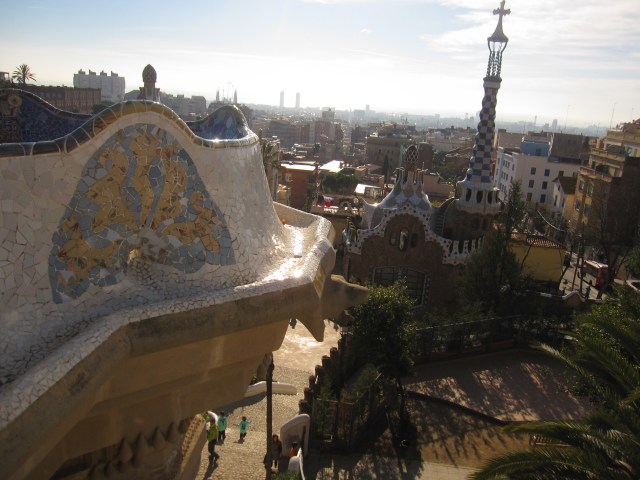
After Hospital de la Santa Creu i Sant Pau, we climbed the narrow roads to Park Guell, another of Gaudi’s triumphs. Once there, I ascended staircase after staircase into a bustling, open-air market, filled to a crowd with photo-happy tourists, blanket vendors and performance artists. During my climb, I passed a series of beautifully organic fountains and stone walls, which were balanced by the eccentricity of Gaudi’s curvaceous, abstract walls and sculptures, flanking a cavern of tiled pillars. The pillars created an echoing den, filled with tourists listening to the native musicians and performance artists, and reflecting the rainforest-like sounds of red-green parrots and frogs in the lush forest surrounding it. More even than the garden, it was these sounds that moved me, as if Gaudi himself had ordered the animals to call in accordance with the buxom, flowing lines and flowery decals of Park Guell.

We finished our tour atop Montjuic (named either for an ancient Jewish cemetery or the Roman god Jupiter, depending on whom you ask), where we had a beautiful lunch at La Terraza. The restaurant sat cliff-side, where its multi-level terrace patios faced all of Barcelona and its slow descent into the sea, making for a breathtaking view.
After a lunch of freshly squeezed apricot juice and ‘crunchy baby goat lasagna’ (I’ve made it my goal to eat the most preposterous meals I can find on every menu, so far with mouth-watering results), we walked down the little, tree-lined street to the Fundacio Joan Miro, where I spent hours wandering the white hallways, fervently drawing out my sketchbook and colored pens every time I saw something memorable, which happened more often than not.

In addition to one of the largest permanent collections of Miro’s work, the museum had a large selection of noteworthy modern art, and was exhibiting an impressive show dedicated to modern British paintings (including one of my favorites by Lucien Freud).
The majority of Miro’s work in el Fundacio was sponsored by the art enthusiast John Pratt, founder of the gallery in his name, La Galleria John Pratt, which has exhibited work by Donald Baechler, with whom I’ll be spending the rest of my Senior Project on returning to the states. In seeing the work collected in the Fundacio, I saw the common thread of abstract modernism and expressively drawn and painted works of art, which in many ways reflected the beauty of Baechler’s paintings and prints.
After fully exploring the museum, we took a tram down the mountain, and shopped our way up Passeig de Gracia until our bodies ached from the day’s walking. At eight, we were the first patrons in the restaurant (dinner usually doesn’t start until around 10:00 on weekends; our ‘early’ dinner was a clear sign that we were tourists), and chatted in English with the waiters while they served us a variety of their favorite tapas.
…
2/20 We are in the home stretch. With only one full day before another seven-hour flight (dios mio!), and a to-do list that’s been almost completely crossed out, Barcelona is slowly becoming a memory, or at least the beginnings of one.
In the past three days, I’ve visited La Casa Batallo, La Sagrada Familia, La Pedrera, Montjuic, Park Guell, La Fundacio Joan Miro, Museu Picasso, Santa Maria del Mar, the Barri Gotic, Las Ramblas, Barceloneta (Barcelona’s old city, with an ancient execution square, Roman aqueducts and city walls and an endless maze of narrow streets), Palau de la Musica Catalana, Parc de la Ciutadella, and countless shops and restaurants. I’ve tried new foods and adapted to Catalan customs (especially sleeping late and staying out and about at night!); I’ve even learned a few words of Catalan to sprinkle into my Spanish! More than anything else, though, I’ve laughed. When you’re here, with the warm sun browning your skin and the breeze catching your hair in every direction, it’s hard not to.
We started this morning early, before even the breakfast cafés were open (which happens at the earliest, at 9:00). We walked through the empty streets, avoiding the half-full wine glasses and bottles that littered the street like dead soldiers after a raucous Saturday night, until arriving at Gaudi’s unfinished masterpiece, La Sagrada Familia.
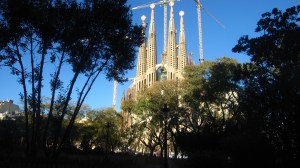
The basilica rose up from the surrounding gardens like a giant drip-sandcastle, with intricate, blistering facades and magnificent yet unfinished towers. When inside, light poured in through the beautiful stained-glass and clear windows, trickling through the tree-like pillars to the people below.
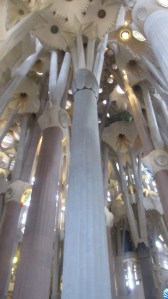

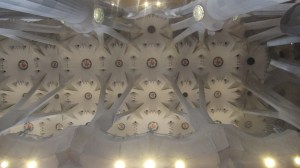
The Sagrada Familia is known for its foresty feeling, as each twisting pillar erupts into a carefully spiraling golden ratio of branch-like arches in the vaulted ceiling. As Gaudi once said, “The tree outside my studio is my greatest teacher”; he channeled his fascination with nature and the outdoors into an abstractly organic, almost indescribable architectural style, which remains completely unmatched even today, nearly 100 years after his death.
After Gaudi, we walked a few blocks to Barcelona’s old city, also known as Barcelonetta. Barcelonetta was once a walled city created by the Roman Empire as a Mediterranean port. With nearly 700,000 people living in a space only seven new city blocks square, it was a vortex of infection, crime and disease controlled almost exclusively by the Catholic Church.
Now, with most of the walls torn down, the remains of the old city have become living relics, filled with beautiful little shops, narrow passageways and laundry lines zig-zagging from building to building.
In one of these narrow passageways was the Museu Picasso, a beautiful, medieval stone building filled with the drawings, paintings, sculptures and ceramics made by Picasso while he was studying in Barcelona. While I’ve seen countless Picasso exhibits, this was one of the few that truly showed his humor and versatility, and his constant fluctuation of artistic style. Mixed among somber, realist paintings were almost pornographic sketches and decorated advertisements, on which he drew moustaches and excessive body hair on the female models, and perverted little men dancing around them with cameras.
With my sister bored with the quiet walking tours of museums and historic sites, my mom and I left her with my father and went to explore on our own.
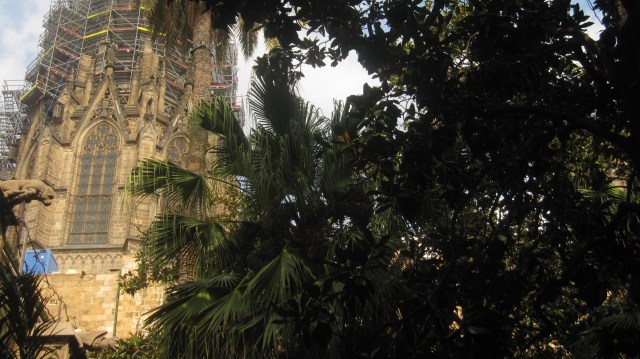
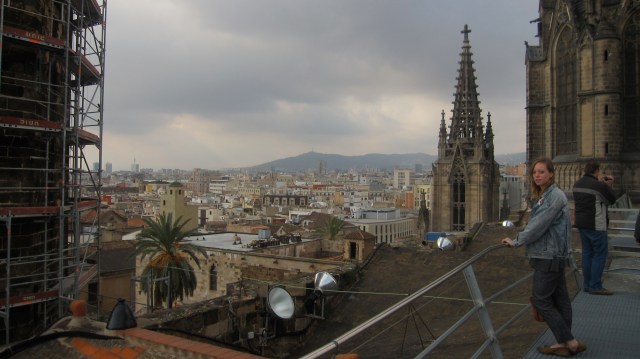
After a light meal of Udon soup and ‘Very Good Rolls’ (we had a choice between either the ‘Good Rolls’ of the ‘Very Good Rolls’, and made the obvious decision), we walked around Las Ramblas (a touristy district near old city) and the Barri Gotic, one of the oldest churches in Barcelona, with a beautiful Mediterranean courtyard and an elevator to see the view from its roof.

Feet hurting from so much walking, we returned to the hotel for a siesta before visiting La Casa Mila, Gaudi’s apartment building which was also known as La Pedrera.
La Pedrera, only a block from our hotel, is still occupied today by a few of its original tenents, but three floors and its rooftop terrace have been opened to the public as a referential museum of Gaudi’s work and the changes taking place in Barcelona while he was creating them.

Finally, after a long and inspiring day, we met together one last time for drinks and tapas at a restaurant down the street. Thanks to the variety of their tapas, and the traditionally small portions, we all tried almost everything on the menu, including an almost ridiculous amount of dessert (we made up for our meagerly-portioned meal with a triple-serving of desserts: hot chocolate cake in orange sauce, the always delicious crème brulee, biscotti, solidified (jellied) g&t with lemon sorbet, and chocolate crème and crackers with oil and salt).
Leave it to Barcelona to surprise you with the unexpected, and always keep it sweet.
Hasta Luego, Emily
 Westtown Senior Projects' Blog