The two sides of Honduras

I´m afraid that I was mixed up the last time I posted, and posted in the wrong place. You can find my other posts at http://alexesinhonduras.wordpress.com/.

Today I find myself a long ways away from where I was the last time I posted, both physically and emotionally. After spending 2 weeks translating for the medical students, I traveled first to El Progreso for a night and then to La Ceiba, where I am now. I am going to school at the La Ceiba Bilingual School for a week before I depart to the states. My host family is incredibly nice, and everyone in the whole country is very friendly, but still it´s un poco stressful for me to be immersed in the language, combined with the need to be polite and happy for my hosts. Every day (today at least), my host family and I wake up at 5 in the morning, eat a quick breakfast, maybe shower, put on uniforms, and speed off for school at a little after 6. Today we were late, so my host sisters had detention, where they had to write 1000 lines. And I thought Westtown could be harsh – but luckily since I´m an exchange student I am impervious to rules. I still felt bad for Stephania and Rossanita, because they took the punishment and didn´t complain a bit. After 8 45-minute class periods and a 15-minute lunch, all the students had an hour or so before sports began to spend time and actually talk to each other, as if they didn´t talk in class. All of the students are polite and friendly, there are just some teachers who are overly forceful with rules. During the sports time, all the soccer players, futbolistas, run onto the field and kick balls around, much more skillfully than I ever could. After that, all the girls had volleyball practice, then everyone had dance practice. By the end of dance practice, it´s already 7 PM, a horribly long day. This is a good week as closure for my trip, to really test my abilities.

Last week, at the clinic in Santa Lucia, I finally was able to be useful as a translator, once I had learned all the important words. If the patient says ¨tengo dolor de todo el cuerpo¨ it means ¨my whole body hurts¨, and then they get diez pastillas de acetomenophin o ibuprofena, para tomar uno cada dia cuando usted tiene dolor – 10 acetaminophen or ibuprofen pills, to take one every day when you have pain. It´s really not super complicated, except for when the patient tries to tell you their life story in the middle of a consult. This tends to apply to most of the patients, so it´s my job to sort out useful information that the doctors want to hear from random facts about life. Sometimes that can be hard, especially when you had no idea you were going to be a translator and only have basic Spanish training. I came out alright, because I always had help if I needed it. This week, I´m not so lucky. I´ll try to keep you posted on how it goes.

-Alex

Week One at the Studio

Emily here –

I like to think that 90% of writing is living, and these past three days have been full of it.

After my return from Barcelona, I had a few hours of catchup before starting the next day with my commute to New York City, where my art teacher helped me find an exciting internship in the artist Donald Baechler’s studio, where the other assistants and I help him with his paintings, prints and sculptures, along with various bookkeeping and organizational tasks. Like all of the other assistants, I am an artist (though still, in many ways, aspiring) and I look to Donald as a sage of sorts: he is an extremely prolific painter and is highly respected both inside the art world and out.

Donald’s work can be seen in the Whitney Museum of Art, the Museum of Modern Art, the Guggenheim Museum, the New York Public Library, the Museum of Fine Art, the Philadelphia Museum, and in countless other museums across the world. He has had almost innumerable solo and group exhibitions worldwide, with his work selling for almost ungodly amounts to the worldly elite (I saw in looking through inventory that even James Brown owns a painting!). More even than the numbers, though, Donald’s character demands respect. His quiet wisdom endears him to anyone he meets, while his Quaker sensibility puts them at ease, drawing even the least learned to his adroitly perfected level.

Starting Wednesday morning, my internship gradually turned from general introductions and thumb twirling to interesting conversations and independent organizational help: most of which meant sorting and unpacking the hidden clutter after a group gallery tour with the Museum of Modern Art in NY. I discussed: recent works by Vik Muniz and Christian Marclay, the state of NGOs in Haiti and across the world, and a recent article in The New Yorker that explored Scientology from an insider’s perspective, all while I was bent over a long, wooden, Chipotle-covered table with Donald and the other assistants. They invited me to gallery shows that they were having or were going to, and offered to show me their own studios whenever I had the chance.

I finished up work at 7:00 and went to meet my friend Allegra, once a classmate of mine at Westtown, who’s now living in the city with her boyfriend. We went to the ever-chic Ace Hotel, for some of the best cappuccinos in Manhattan, where we reconnected over the bustle of the lobby. The ambiance was incredible: a seductive vocalist purred along with the half-hidden jazz band, undulating in perfect harmony with the crowds and the talk and the rolling laughter. I capped my first day with vegan dumplings and a sleepy train ride back to New Jersey, wishing more than ever I didn’t have to leave so magical a place.

Thursday was spent with Donald at Pace Prints, the print studio associated with the Pace Gallery (which, according to Donald, is among the five most important galleries in the city), where we worked on a series of ‘crowd’ monoprints. The crowd is a subject matter relentlessly reworked by Donald; because of its versatility it’s become one of my favorites of his subject matters. For this project, Donald made a series of nearly 70 woodcut faces and skulls (‘Just two eyes, a mouth and a nose,’ as he says), which were arranged like puzzle pieces, inked, and printed on handmade paper. Most of the faces were layered with Chine Colle, a process that glues rice paper under the ink and onto a page during the printing process. This gave the opportunity for the negative space of each face to be a different color, despite the monochromatic inking.

My job during the majority of this was to cut the different colored rice papers to fit the templates of specific heads before they were printed. I was able to choose the color that I thought would best suit each face, and that would correlate with the colors of the surrounding faces. While tedious, the job was fun and collaborative; I met lots of interesting, young printmakers and I learned much more about a medium that I’d though I knew almost everything about. More importantly, though, I felt like, while discreetly, the job I had was making an important mark on the final product, as if it were a signature of sorts.

Thursday’s workday ran late as well; after leaving the studio at 7:00 I ran to Utrecht to pick up supplies before walking to the East Village for dinner with Allegra and friends.

Today was the quietest day of them all; there was only one assistant in the studio other than me, excluding Donald’s personal assistant, who stopped in for a few hours this morning. With no significant work to do, I worked on personal projects until Donald arrived at 2:00 (I arrive around 11:00), and chatted with the other assistant.

When Donald arrived, he talked to us for the majority of the time, showing us pictures of paintings sculptures that he was interested in buying or that he held in high renown. Towards the end of the work day, I helped him sign an edition of prints he’d made while he was in Barcelona a few years ago, which he wants me and one of the other assistants to begin cataloguing in coming days.

After work, I went with Erin, a coworker, to the opening of a show that she and another coworker were in at the Canada Gallery. The opening was packed with exotically-dressed twenty-somethings and smelled like stale beer, but it had a feeling of general excitement and creativity. The show was a collaboration of 20 artists, who made a highly conceptual film, and displayed with it pieces of unrelated art.

A bit overwhelmed by the density of strangers, I left rather quickly, taking the subway back uptown to Penn Station, from where I headed home. Once home, I met with a few friends in their apartment down the street, and we listened to jazz music while talking about our plans for tomorrow, which you’ll hear about soon enough!

Until then,

Emily
Too Many Live Oysters…

Good thing I wrapped up the city in two days…

My last was spent either in bed or running for trash cans!

NOTE: don’t trust raw/live food in foreign countries 😀


But other than that, I just got home, safe and sound!

Healthy and looking forward to my first day of work tomorrow with Donald Baechler.

I’ll let you know how it goes!

-Emily

Explode Up!

I’m angry. I’m sad. I’m frustrated.  The awkward silence fills the cubby of the indoor golf site I get lessons from in the winter. “John, I can’t do it. My club decelerates when I hit impact. I don’t know what else to do”. My nervousness begins to greaten when I realize I have a week left until I leave for the academy. “Casey, I don’t know what to tell you right now. Let’s try squatting, without pushing your right knee out, and when you hit impact you’re going to explode up, quick, and with strength”. He proceeds to hold my body down while I try squatting lower and lower. “Now, explode up!” he says. I push upwards as hard as I can but I seem to be stuck in the same position. “See? I can’t get my body up like that. And if I do, my club seems to get stuck right when I’m striking the ball”, I say. John looks unhappy with me, but it may be he’s just unhappy with his teaching. I cannot tell.

When John makes a certain look, with his hand over his chin and a confused gaze in his eyes, I know that he’s thinking. Every lesson I see this look and it makes me worry. Does he really not know how to help me? I think to myself. This time, he turns to me and tells me that I cannot get any more power from my arms, and that my legs and thighs is where the rest of my power now needs to come from. “Alright”, I say, with sweat dripping down the side of my cheek that could be easily mistaken as a tear. Wait, was it a tear?

“Casey I know you are mad at me. I know this is hard, but you’re going to have to do it. There’s no possible way you can get enough power and hit long enough with your swing now. Do you understand that?” he proceeds to tell me. A small pause. I try to bring myself together so I don’t start crying. Why is this all happening to me now? Why didn’t he tell me this earlier? “I do, I’m just. I’m just not sure how to fix it. I understand the whole exploding thing but it seems to weigh me down, so that the club cannot swing fast. It feels as if it’s stuck” I finally am able to say. “I guess I get that,” he says. “But how de we fix it?” he asks again. Another small pause. By this time it’s 5:20. I was supposed to be done 20 minutes ago. Doesn’t he have another lesson? When can I leave? “John, this just isn’t fun. I hate this” I continue to say to my coach. “You will be fine Casey, you will be fine” he says. He finally dismisses me from the lesson and I slowly walk to my car, thinking to myself: I hate this. I just hate this.

The Dragon House and Gaudi’s Spain

Today marked the official beginning of my journey with my family to Barcelona, Spain. I travelled thirteen hours into the future, from Thursday afternoon until Friday morning, and managed, somehow, to still have energy enough to explore. After getting off the plane we were met with an overly enthusiastic driver named Toni: a nearly indistinguishable Spaniard with olive skin, short, brown hair, flattering stubble and prominent, bony facial features. As he drove us the half hour from the Barcelona Airport to our destination, Hotel Majestic on Passeig de Gracias, he excitedly discussed with us the happenings of his city, and the recent ups and downs in terms of Barcelona’s economy and tourism.

On our drive, I was immediately struck by the mixture of classical and modernist architecture both inside and outside of the city. From Gaudi to graffiti, every building glittered with humanity and creative ingenuity, not to mention a plethora of multicolored, divinely inspired mosaics. On leaving Toni and the world of Barcelonan automotive transportation (most of which is run by Mercedez Benz, Volkswagon and Audi, a fine example of the comparatively blasé sense of American quality… but that’s another story), my senses overloaded with the vibrancy of my settings. If nothing else, Spain is sexy. It’s well groomed, it’s generous, it’s exciting. It stays up late, and it knows how to make you smile.

After a much-needed espresso and selection of tapas, we checked into Majestic and unpacked our luggage to join the rest of the city in their mid-morning siesta.

Our hotel is on the Park Avenue of Barcelona. It shares a building with Chanel, and a block with Hermes and Louis Vuitton. Sitting on the balcony outside of my room (almost every room or apartment in central Barcelona has a balcony; as Toni described it, “They chop off the corners of buildings for all those beaaaautiful terraces… who wants a window?! No one wants a window. You must go outside and be a part of the street”), my vision was overwhelmed by the constant whirring of motorcyclists and picture-snapping tourists, leggy-models and Armani-clad homes.

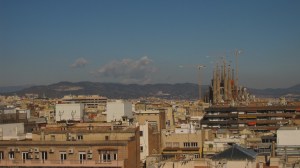
We reconvened after our early morning siesta on the roof of Majestic, where my sister was dying to visit the swimming pool. To our surprise, the roof was a thousand times as splendid as our little rooms and balconies; the azure pool glimmered in the sunlight, reflecting the mountainous, city-wide view that circumnavigated it. A bartender brought us snacks and drinks as we leaned over the latticed railways towards  La Sagrada Familia, Montjuic and the Mediterranian, breathing deeply the smell of lilacs, orange trees and palm growing on a terrace beneath us.

As the sun peaked in the sky and the locals rolled out of their beds, we jostled our way across the street, weaving between bicyclists on community-loaned bikes, subcompact cars, motorcycles, and all of the endless picture-taking tourists. Like many of the tourists, we headed for the line into La Casa Battlo, a private home designed and renovated by Antoni Gaudi, the riotously popular local architect and designer of La Sagrada Familia (as yet unfinished), and the controversial La Casa Mila (also known as La Padrera), both of which I hope desperately to tour before my time here is through.

I like to call La Casa Battlo ‘the dragon house.’ It was built as a testament to St. George who slayed the dragon (the patron saint of Barcelona) and the multilevel house serves as a functional shrine, encapsulating their infamous battle. The dragon’s spine curves its way up the banisters and walls of the curvaceous, asymmetrical house to the roof, where it dips and peaks under George’s cross-shaped sword as it’s ultimately defeated. On either side of the main stairway, which circles around a beautiful, blue mosaic atrium, are hallways and smaller stairways that are indistinguishably bony and rib-like in their curved, white arches and spirals, which are meant to depict the bones of the dragon’s previous victims.

Antoni Gaudi; La Casa Batallo

As is many other masterpieces of Spanish architecture, La Casa Battlo is naturally lit, with its atrium and windows gushing with Barcelona’s clear sunlight. When approaching the outdoors, though, the brilliancy of light is almost overwhelming. In taking photographs and making quick sketches, I was entranced by the interesting shapes Gaudi used in his windows and towers, which cast brilliant highlights and shadows across the space, as if the spaces themselves were imposing their voices upon the viewers and the floors and walls around them. I remember standing on the roof, watching as the shadows of an iron-barred window slowly cast themselves over a tourist photographing the terrace below. He snapped the picture and walked away.

I walked away, too, but not before capturing the little circle of shadowy black on the clay floor. I think that Gaudi’s magic reflects, and even promotes the magic I see in Barcelona. It is as though even the mundane is brought to life, reflecting the everyday as if in a funhouse mirror. Everything is slightly distorted, and looking makes you think.

I was telling my father, in a little bagueteria, about the power that South American and Spanish writers have had on me, about the reality I’ve found in their unbelievable stories. Barcelona is like that; Gaudi is like that. It wouldn’t be quite as magical if it followed any standards; it wouldn’t be as real if it made any sense.

With love from Barcelona,

Emily

2/18/2011