The Pace Increases

Hello!

My second week interning at Jigsaw Productions went very well. This week started off with an interesting adventure. On Sunday I decided to visit the Metropolitan Museum of Art, one of the coolest places in the city. When I had gone as a child, I was not able to appreciate all that the museum had to offer, unless you want to count the Arms and Armor display as the entire museum. Being older, though, I was excited to see the museum on a grander scale. All in all, the visit began well enough. I started by viewing the Egypt exhibit, followed by the Sculpture, 18th Century Home, American Artwork, Arms and Armor, and Exotic Instrument displays. When I finally ended up in the European Paintings exhibit, I realized that I had no idea where I was in relation to the exit. I had forgotten to pick up a map on the way in, so I had no way of knowing where I was in the sprawling Metropolitan Museum. Normally, this wouldn’t have been much of an issue, but I knew that it was getting close to closing time, so I wanted to be cognizant of where I was so that I wouldn’t still be wandering around the exhibits while the museum was being closed down. I enjoyed the challenge of finding my way out of the museum well before this became an issue, so I didn’t end up in a situation similar to Claudia and Jamie from The Mixed up Files of Mrs. Basil E. Frankweiler. Though I’ll admit, that would have been fun as well.

Apart from this minor incident, my week went exceptionally well. Unlike the first week, transportation never proved to be an issue. This took a weight off my shoulders, which allowed me to put my full energy into my work. This week, most of my activities were focused on scanning and photo logging. The consolidation of my work allowed me to perfect my skills in both, and to get into a working rhythm. It felt exhilarating to constantly challenge myself to work at a faster pace, while still creating the same high quality product. I was also happy to know that the people I was working with were appreciative of my work. Throughout the week, I had a chance to have lunch and trade jokes with them, which allowed me to get to know them better. This made working with them even more enjoyable. I also gained a lot by just listening to them, even when they weren’t talking to me. From their conversations I learned about the various processes that surround getting the rights to archival footage and pictures. I can’t tell you any specifics due to my confidentiality agreement, but I can tell you that there is much more thought and planning that goes into this process than you would imagine. Hearing about the complexities that surround this process was fascinating, and it really helped to broaden my understanding of the how a documentary is made.

Speaking of the process that documentaries undergo before completion, I was able to attend a meeting at which the Jigsaw staff members who were leading the project I was assigned to met with their adviser and editors. During this meeting, the adviser and editors would ask for updates on certain tasks, cancel others, request footage, begin inquiries, and discuss other various topics. This provided a context and helped me better understand the importance of what I was doing when I logged and scanned photos. These photos fulfilled the various requests and needs of the editors and advisers. It helped make my work more enjoyable and meaningful to me, since I had a more exact idea of the purpose of my work.

Before I even knew it, the week was already over, and I was very happy with what I had accomplished thus far. I was completing my assignments efficiently, gaining more and more knowledge of the city, and constantly building confidence as an intern. At this rate, week three will definitely be the best of them all. I can’t wait for it to start!

Cheers!

Geoff
Into Thin Air

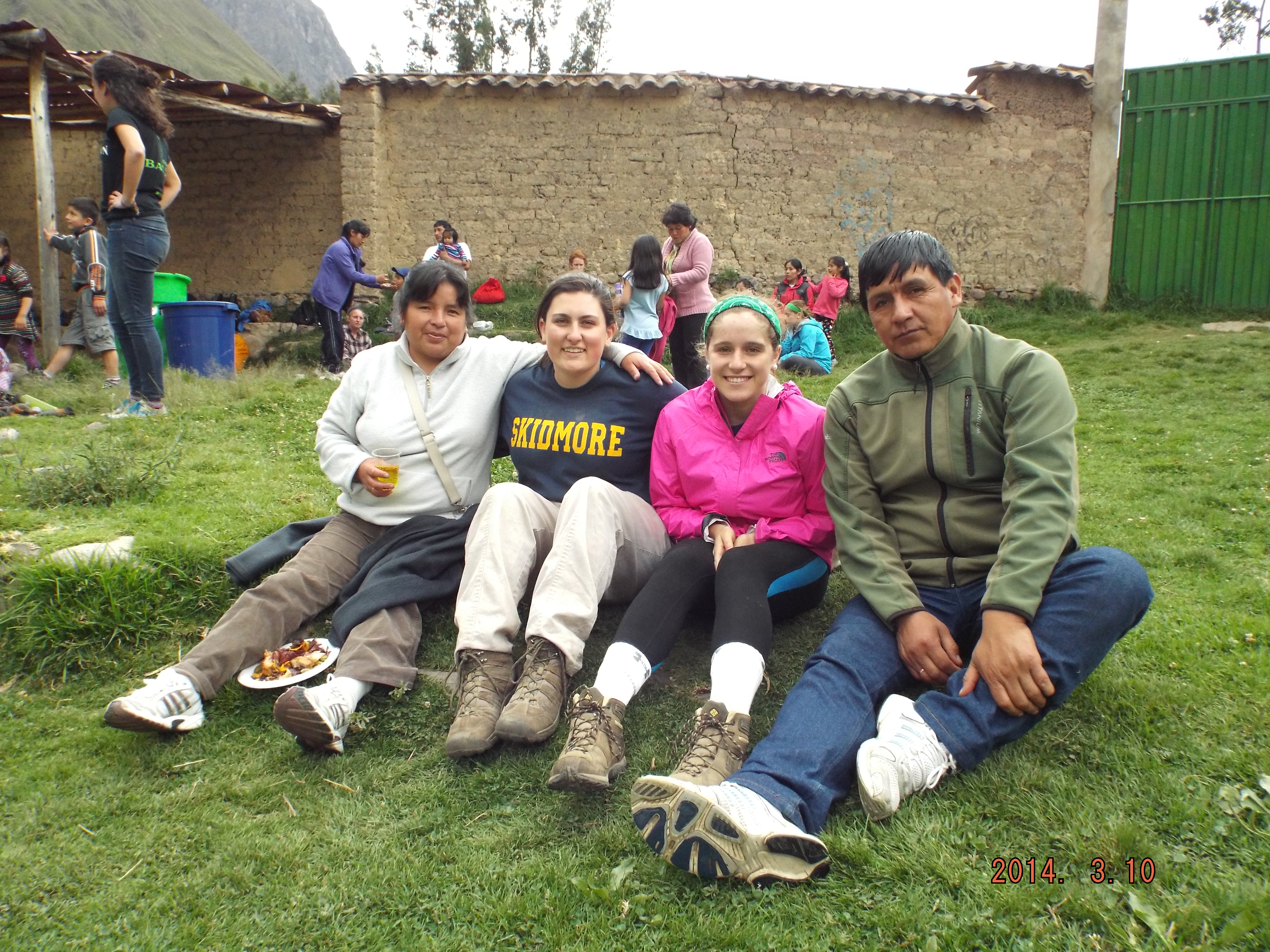
When the students saw on our itinerary that there would be an “overnight trek high into the Andes,” they asked for more. “Can’t we do another one?” So before we departed, Maria and I asked World Leadership School to add a day of hiking to our plans. The representative knowingly chuckled, “Let’s just see how this one goes first. It’s hard, you know, climbing at those altitudes.”

Continue reading “Into Thin Air”

3/13/14 – Parting Thoughts

We left Ollantaytambo and headed to the bigger city, Cusco, where we would spend our last night and complete our final purchases before our flight to Lima and then to JFK. This was a nice hotel that had a beautiful outdoor courtyard with gardens and a breakfast room that was made entirely of windows. When we arrived in the afternoon we split off to do what we wished and were only told to stay in groups of at least four. I stuck with a group of five other girls and we decided to head right out and do some shopping. We had been consistently told throughout the trip to save our money until Cusco because everything would be cheaper there, so we were in desperate need of gifts for our families and friends at home. We walked down to the different markets where there were many vendors selling colorful tapestries, sweaters, t-shirts, jewelry, and other trinkets. It was hard to resist all of the beautiful things they had displayed. The vendors were pretty aggressive but we quickly learned how to bargain and were proud to tell our friends of the good buys we made.

Continue reading “3/13/14 – Parting Thoughts”

3/9/14 – The Saddle

I opened my eyes and saw a tent above my head. It was day two of the overnight hike in the Andes. We hiked most of the day yesterday and then reached our campsite at about 3:30 in the afternoon with time to relax before dinner. It had been hot all day but there was a significant temperature drop when the sun disappeared behind the mountains, and after dinner, when it was dark, we all scurried back to our two-person tents to bundle up and go to bed, despite the fact that it was only 8:30 PM.

When I woke up my stomach was churning, but I ignored it—too cold to think about getting up to get medicine or anything. After breakfast at 7:30, those of us up for the challenge began our hike further up the mountain to the “saddle” between two other mountain peaks. The journey up probably took about an hour and fifteen minutes, but it was very strenuous and hard to breathe. This was probably one of the most physically demanding things I’ve done in my life. We were headed to Inti Punku (Puerto del Sol) or the “Door to the Sun.” When we spotted this door up at the saddle from a distance it seemed much closer than it was in reality. When we finally made it I felt incredible. We were actually standing on top of a mountain in the Andes. I kissed the doorway out of pride when I walked through it, and we stayed up in the little square of ruins for about 45 minutes, taking pictures, journaling a bit, talking, and congratulating ourselves. I tried to memorize how I felt at that moment, looking overtop of the surrounding mountains, so I could save it and feel it again later at exciting time, like maybe when I get into college or something.  We were 4,000 meters high.

Going down was a lot easier cardio-wise, but there were many loose rocks and the trail was rather steep, so it was slightly startling when I slipped every once in a while, especially with the steep drop easily within reach.

In the end, we all safely made it down the mountain and, looking back, I think this was my favorite part of the trip.

Reflection – I am home!

The weather is cold here and the showers are hot!

It has been harder than I thought re-adjusting to home and remembering to do things like throw my toilet paper in the toilet and drink tap water. Reflecting on Ghana I realize what an amazing experience it was and how much I have grown from those twenty days. I realized that public speaking is only as scary as you make it and that I can teach and lead a class. I learned about a new culture and made friends that seemed so different at first. I learned how to dance Azonto, eat fish with bones in the dark, play drums, break up middle school disputes, navigate markets, laugh with strangers, sweep with palm fronds, make cinder blocks, pound fufu, enjoy cold showers, wear Ghanaian fabrics,  express local customs, think on my feet in class, and barter with market woman who don’t speak my language. The culture of Ghana is so different yet I found so many parallels with home. What I loved about Ghana was the sense of community and joy the villages held. They had chiefs and elders and everyone was responsible for their friends and neighbors. I felt safe and accepted walking through the towns to shop, hangout at the local dance spot, watch soccer, and visit where my kids lived. I have gained new found respect for the amount of effort it takes to live in third world countries and a slight disgust for how unfairly we live with our fancy electronics, kitchens, washing machines, cars, excess food, and clean water. Teaching the kids and seeing how driven they are while experiencing how they live has made me want to help give them the opportunities I have been given. I wish I could sponsor them all, but, I have chosen to sponsor Bernard, one of the many students I fell in love with. I grew closer to my Westtown friends who accompanied me to Ghana and became close with teachers I had never talked to before. In Ghana I learned what it was like and how to handle standing out in the crowd, I experienced the power of religion and a different code of ethics, and I became confident in my ability to handle myself in a new place. I have got the travel bug and I can’t wait to see where it takes me next.

3/6/14 – Block by Block

Today was our first morning waking up in our host families’ houses. I roomed with Maddie and we lived with a family of four kids: a boy who was 28 named Javier, a girl named Eliana who was 25, a 16 year old boy named Luis, and a 13 year old boy named Alex. We had a room to ourselves, and a shower with hot water, so we were very happy. The family we lived with was a little shy at first, and it was difficult for me to communicate with them because I hardly speak any Spanish, but Maddie helped me say some things, and I tried to be as polite as possible because it was very generous of them to open their home up to us and cook us three meals a day (which were very good).

Maddie and I woke up early, even without an alarm clock, because Ollantaytambo (the name of the town where we stayed) is bustling by 6:30. We got ready in our work clothes for the first day of service at the local high school, and after breakfast we walked to the school and met up with the group. I loved seeing the mountains on the walk to school. I don’t know how the kids here get any work done; I’d be too busy staring out the window!

Our service project throughout the trip was building a wall at the high school. The trench for the wall was already dug and we were to move cinder blocks and mix cement and do other preparations for the wall. Right inside the school’s gate was a pile of 1,000 cinder blocks and another 1,000 were on their way. When the new shipment was delivered, our whole group made one long assembly line and passed blocks down the line. The people at the end of the line made a new pile, closer to where the wall was actually being built. Some of us were skeptical as to why the blocks weren’t originally delivered closer to the wall trench, but it was easier to just move blocks and not ask questions, because that’s not how they were delivered and they had to be moved anyway. This task of passing cinder blocks down an assembly line seems quite simple but, block by block, the tensions grew, especially when there was a holdup of blocks because someone was struggling with one or because their grip slipped. When instances like this happened, the blocks built up and we were at a standstill. A holdup was usually followed by much yelling and talk of, ‘fixing the system.’ “Come closer!” or “Spread out!” were common cries down the line. Despite many attempts to fix the chinks, eventually there would be more yelling and frustration. I believe that this was more a product of the tediousness of the work rather than the fortitude of the group. After about two hours and 1,000 cinder blocks, however, we were all thrilled to be finished so we could act civilized again, and rest our shaking arms.

After lunch we got to relax a bit and play some team-building games. We were happy to go home that night to shower and veg because it had been a long, tiring day and we wanted to get some good sleep because the next morning we were headed off to Patacancha (a weaving community where we would learn how local weavers spin and dye their yarn, and how they create the beautiful woven things we see sold in the markets). We would even get to do some shopping!

3/3/14 – Inca Sun Temple

After a quick breakfast with the group we walked all together to the base of the sun temple ruins. We met up with a local guide and he led us up the ruins, explaining Incan history along the way. Every activity we do here seems to involve ‘a short hike up the mountain,’ so I often feel a little winded, but we are trying to avoid altitude sickness as best we can by staying hydrated and drinking coca tea (a tea made of coca leaves that supposedly helps prevent this sickness).

The Inca engineering is incredible. The steps we climbed up were granite rocks about 2’ wide by 4’ deep, and very thick. I can’t completely wrap my head around how these huge rocks were transported. The ancient people harvested them from the top of a neighboring mountain, and then used timber, ramps, animals, and their own physical strength to haul them up to a very high point on the mountain of the sun temple. I wonder how many years and people it took to do this. There is evidence here at the sun temple of the Spanish invasion because some rocks were abandoned on the ramp on the way to the temple. How disappointing it must have been to not be able to finish.

The temple walls are built like a giant puzzle—each fitting into the other with such precision that you could not fit a sheet of paper in-between them. I tried to soak up as much history and knowledge from these people as possible. The architecture here is amazing. We learned that trapezoid-shaped doors and windows are a distinctive feature of Incan architecture and this is an easy way of differentiating ruins.

The placement of these structures also amazes me. The Incans looked at the nature around them and the shapes of the mountain and then built in a way that incorporated the earth. Unlike in today’s society, where we destroy nature and build up our own towers, the Incans embraced nature and trusted its guidance for their architecture. They seemed to have had no problems with landslides, earthquakes, or erosion; after all, mountains have been standing for quite a long time…

A New Perspective

As I settled into my peruvian lifestyle, I became very aware that the trip I was on was not meant to make you feel settled (in the best way possible). On Tuesday March 4th, after another great breakfast (the food was always fantastic), we met our host families outside of our hotel rooms, and they helped us carry our things a few blocks away to their homes, which were spread out all over the small town. Our group had been divided into groups of 2 or 3 and each assigned to a family. I was lucky enough to be roommates with Newell! I had become increasingly more nervous to meet the family, mostly because out of all the groups, Newell and I had the least amount of spanish experience; me having none, and Newell being in Spanish 2. Leaving the hotel was completely throwing me out of my comfort zone and I have to admit, I was scared. Babina, my host mother, greeted us with a big kiss on the cheek and Poncho, my host father, a friendly hug. Their house was very cute. Newell and I shared a room with two very comfortable beds. Most of the houses in Ollantaytambo had an outdoor center. In my house, there was an outdoor courtyard with all of the room surrounding it, meaning that all of the doors to each room you had to go outside to enter. I didn’t understand much of what they were saying, so I just smiled and nodded. They sensed how tense I was and offered to play UNO. Once my host siblings, Yessica and Yack came home from school, Newell and I soon learned that UNO was a household favorite. We played for 2 full hours! I wrote in my journal that night, “I am starting to realize that their family is so similar to what we know as a family, along with their traditions. I am beginning to understand the uniqueness of the experience I am having. Even though I cannot understand almost all of what they are saying, to be able to sit and observe is the most influential thing. It is so cool to realize that they are just a small loving family living in this big world, and I already know that I will think of them when I go back home.”

Here is picture of the happy family who, although we had trouble bonding with, grew increasingly more comfortable with and accustomed to living with. I realized over my 6 days with Poncho and Babina, that I never really felt in my comfort zone, but I learned so much about life of the people in Ollantaytambo. The most important thing I took away from them was that people share and spread love all around the world no matter the circumstance, level of education of financial situation. I feel truely bless to be pushed into this opportunity where I would take so much. Even though we were maybe not the greatest match for each other, I am really thankful they were able to open up their home and open up my eyes to their lifestyle. DSCF9541

Over the next few days, we started our service project. It was very exciting! The town of Ollantaytambo had just finished a brand new high school. It was beautiful, and everyone was so excited for the opening day! Our task was to help build a wall on the back side of the school. Over the next couple of days we would unload 1,000 cinder blocks from the back of a truck, move 2,000 cinder blocks from the front of school to the back of the school where the wall was being built, carry dirt, cement, and rocks and get very dirty. It was quite the task. Our group had moments of high tension, laughter, arguments and collaboration. My one wish for the trip would be that we could have made more of an impact on the wall, but unfortunately because of the time consuming labor we didn’t get to see it finished. Overall it was a wonderful experience because we all really came together as a group.

Here is a picture of the first opening day of school on our final day of service! It was so great seeing how excited the kids were to start classes!

The most influential experience over these few days was the Weaving Community. On March 6th, after a long morning of service, we boarded a little bus and took a very bumpy, very scary ride up the side of a mountain to the community. It was incredible. The women were seated, all in traditional dress, working very hard on their pieces. We all gathered and watched them, snapping pictures and listening to our guide explain their lifestyle to us. They used all natural dye’s and carefully spun the llama fur into beautiful yarn. We were each paired up with one of them, and they helped us weave our own bracelets! It was so cool. The woman I worked with was so sweet. I had no idea what she said at all, but I just kept telling her things about our trip and how great things were in english even though I knew she didn’t understand either. She had a great smile and it was great working with her.

After we finished weaving our bracelets, I thanked the woman I was working with and we walked through cluster of houses where they lived. We went inside a house and got to look around. It was then that I realized that what I was seeing was unbelievable poverty. The house was hardly big enough for a few people, and had no furniture. There were no windows or chimneys, and the people often had respiration issues. There was no running water. It was hard to understand and accept that people were living in these conditions. I realized that these women put on their traditional dress and work hard on their beautiful creations for people like me and the rest of the group, who have come to learn about peruvian culture. It surprised me that people with such unique and incredible talents are forced to live in such poverty. But at night, when they go back to their houses, they have to live in these conditions, without a bed, water, or even fresh air. I was truly taken aback, and humbled to have met such simplistic happy people who live with so little, and wish so badly that I single handedly could have helped them in that moment.

Here is a picture of the women, seated, working tirelessly on their wonderful creations.
This is a woman stirring a pot of yarn. She has just added the natural dye which she extracted from a plant and is now mixing it into the pot.


“Las Tres Palabras”, from our Spanish Exchange Group Experience

Image

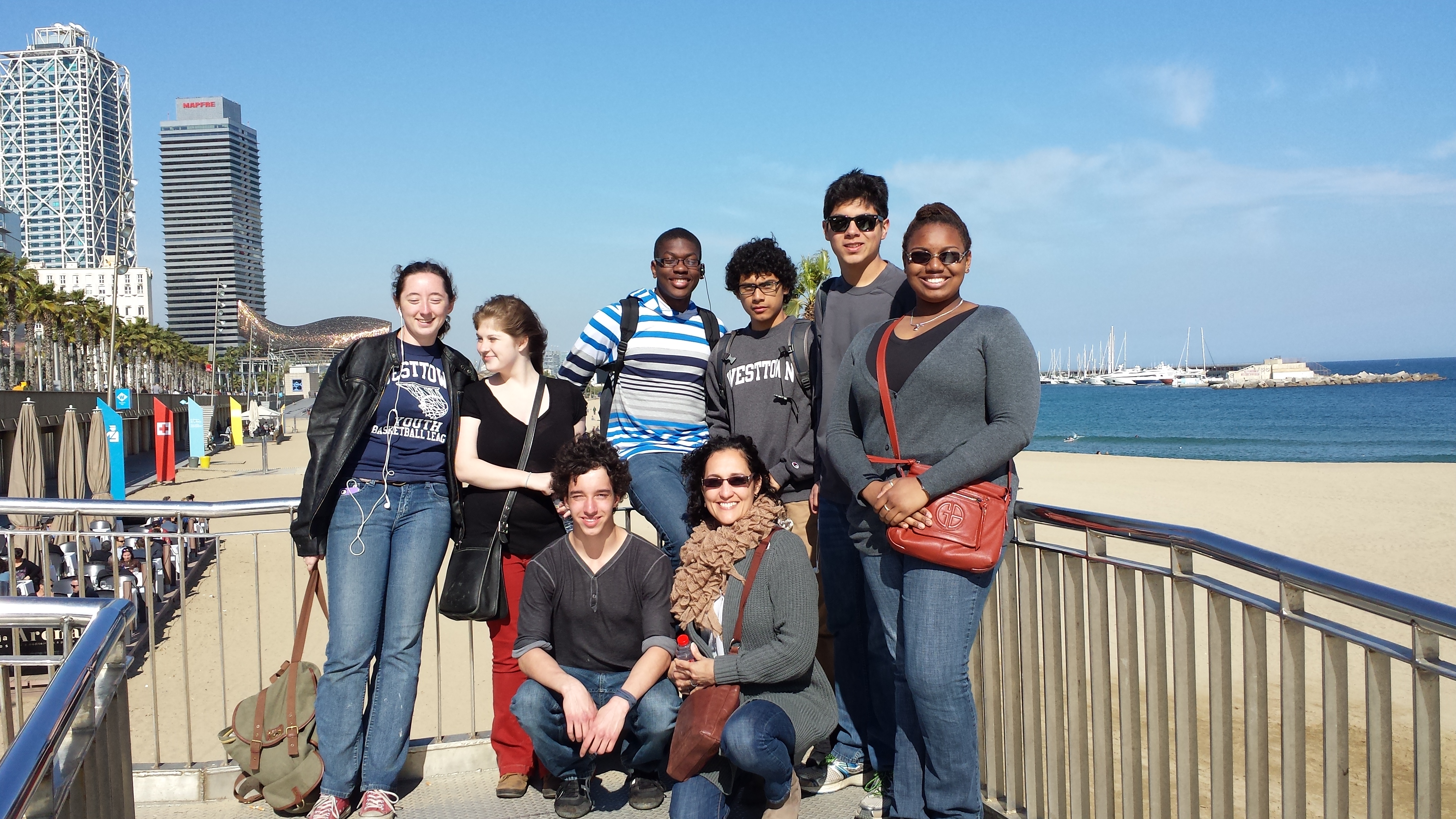
Our seven Westtown Exchange students were really excited to come to Spain with the purpose of reinforcing their Spanish language skills and knowledge. We “regret” to inform you that this intellectual exercise of understanding and properly function in the intense Spanish immersion environment has been quickly abandoned, for a most challenging and thrilling pursuit; the pursuit of cultural enlightenment. After experiencing how the local cadence, gestures and accents of the language sound so foreign and illogical in different Spanish cities, (compared to anything that they had experienced in the classroom) they realized that there is “more to language in life… but don’t ask me what!”. Their Westtown language classes had prepared them to speak their minds; however, Andalucía and Cataluña made them realize that, all what they needed to do was Breathe (Respira), Look (Mira) and Listen (Escucha).

 Respira…and rejoice! The joy of breathing warm air in Madrid for the first time in too many months was the kindest welcome of the land. No matter how tired and worn out we might have been from our travels, the gift of “breathing it all in” energized us. Each day has had glorious sunny weather, while getting around a new place can also be incredibly frustrating. The arrival to Sevilla felt like an isolating experience for some, and a thrill ride for others. In either case, we began each day gathering in air in our lungs and launching our speedy steps in all directions through the narrow cobblestone streets and alleys of Sevilla. In each Place, we “took it all in”, but could not keep it all to ourselves for long. The day trip to Granada and The Alhambra took all our breath away, and so began our “exchange”.

 Mira! The Andalusian region is built on top of layer upon layer of rocky land and historic buildings. Each layer conveys a story of great importance in the history of mankind, from early human civilizations, the Roman and Islamic Empires, the Christian Reconquista to the seat of the colonial expeditions to America until present day. In essence, we witnessed a bountiful panoramic view of history that can only be summarized by this visual exhortation.

Escucha. Each day consists of a fast-paced list of guided sightseeing activities. One student shared that it was hard to process all the information he was receiving just by listening during this trip. “I don’t know what is important and what is worth ignoring!” I’m sure memory and time will sort it all out. We do not need to hold on to so much in order to enjoy where we are. It is during the pauses and quiet times between each activity that we find the sounds of “Place” and share informally the wisdom learned with each other. A quick glance, a sigh, a grimace, a giggle…we do not need to pick a language on these instances. We all pull back and let our ears listen, letting our minds “understand” each word spoken from the physical aspects of the place.  In the Alhambra, the soft flow of water in the garden fountains of the palace led us to explore all the rooms in the castle. In Cordoba, the tight alleys and streets of the Judería echoed, bouncing our words back to us in defiant confusion. In the last few days, as we begin our stay in Barcelona, we are deciphering the coexistence of the Catalan and Spanish (“Castilian”) language spoken in this region. Had we not learned at this point to “breathe and look” for clues of context and the interlocutor’s sense of urgency, our minds would have reached la “locura”!

 As we begin the last part of our trip, we are truly grateful for the wonderful hospitality and exceptional accommodations that the Aula Ecola Europea’s host families have provided for our students here in Barcelona. We look forward to Aula’s exchange student visit, when we will have the opportunity to return the attentions, host them warmly (Think Spring!) and show them the fascinating air, views and sounds that Westtown has to offer.