Elephants!Elephants!

Chiang Mai is exhausting!  Yesterday, we went to an elephant sanctuary!  We left early in the morning and traveled in vans up a mountain.  On the way there, we watched a TV episode called Caught in the Moment which showed all the work the elephant sanctuary had been doing.  When we arrived, we were led upstairs to a patio-like roof.  We sat on pillows around long tables as the cool breeze of the mountains played with our hair and our tour guide gave us the lowdown.  Always wash your hands before feeding or touching an elephant.  Don’t pet James Bond, one of the dogs; he might bite you.  It’s a good idea to always approach the elephants with food; otherwise, they will be a lot less amiable towards you.  Try to only touch the elephants on their sides and try not to touch them on their trunks too much.  They don’t like that.  Only approach an elephant if it’s with its Mahout, or keeper.  The rules were a bit overwhelming, but did not damper our enthusiasm one bit!

First, we fed the elephants their snack.  As we went downstairs to the porch the most beautiful scene opened up before us.  A vast green valley littered with water buffalo and elephants stretched out to a hill covered in trees.  The hill looked like it came straight out of a picture book; there was a silhouette of the trees and vines at the top of the hill that looked almost unreal. In the valley, there were trees as well.  Around each tree was a wooden porch on stilts.  Some of the trees even had small buildings built around them.  To the left of the porch we were standing on was a long walkway high above the ground.  The roof of the walkway was built from hay.  They nicknamed the elephant sanctuary “Elephant Heaven,” but I don’t think they realize how accurate the name really is. 

The elephants lumbered over to us being led by their mahmouts.  We filled baskets with various fruits and began to feed the elephants.  We would hold out the fruit towards the elephants and they would take it, wrapping the end of their slobbery trunks around it and bringing it to their mouths.

There is so much more to write about our day with the elephants, but I am afraid I don’t have the time right now.  Hopefully, I will finish telling our story later tonight (your morning!).

Enjoy, and thanks for reading!

Ramallah 1

As predicted, now that we are staying with families we have much better access to the internet, and so I will be able to write quite regularly for the next five days, at least.  We left Bethlehem this morning, and arrived at the Ramallah Friends School this afternoon, where I met my host family and came home with them.  After a good dinner and an evening walking around the city/eating amazing pastry, I find myself here, getting ready to go to bed and prepare for visiting classes tomorrow.  In many ways I feel like the time in Ramallah will be a highlight of this trip (if I can say that there is only one…); we really get a chance to interact with kids our own age, and get for form real connections over more time than just one hour long information session.

In reply to my last post, I was asked what an individual can do to reduce the violence, and my answer is still this: it is to do whatever possible to work against the dehumanization of people on BOTH sides.  Why?  The human brain has safeguards built into it which make it extremely difficult to kill another human being.  There are two big things which enable a person to take a life: societal/group acceptance (lack of which is what led to so much PTSD in Vietnam vets.) and the dehumanization of the other person. (that info came from a book called On Killing, the author of which I do not remember).  It stands to logic, therefore, that if we can attack those two factors, then people will find extreme violence much easier.  Earlier today we also visited Yad Vishem, the Holocaust Memorial museum just outside of Jerusalem.  In it, we were taught of the extreme lengths that the Nazi command took in order to make everybody believe that the Jewish race was not human, and in many ways succeeded, thus empowering the average soldier to commit some of the atrocities which they did.  The much-repeated phrase about the Holocaust is “never again” (which I find ironic, because one of the things they talked about quite a bit was walling off ghettos and blocking travel in and out of  – cough cough – Gaza… but that’s a rant that I don’t think I will go into right now).  Seeing as how it was the dehumanization of Jews which permitted the Holocaust to take place, should not the Israeli government be a little more sensitive to the fact that they are dehumanizing themselves in they eyes of the Palestinians through the vessel of the soldiers, at the checkpoints and occupying the West Bank during the second Intifada?

Err… Sorry, got a bit off track to answering the question there.  What can one actually do to help this.  In all honesty, I do not really know.  There are many organizations working for nonviolence, human rights, etc. (Rabbis for Human Rights, for one), and supporting such a group could help.  One could also pressure our government to squeeze Israel much harder in terms of following UN resolutions and ending the occupation/oppression through the venue of the $3 billion of our tax dollars we give to Israel to bankroll their military each year (please tell me I’m not the only one a teensy bit uncomfortable with this… especially with our current economic situation/budget deficit?).  That all said, there are probably other things one can do, but I am not really there yet in my thinking: I am still in the processing and gathering of information stage, not the solution finding one yet.  I shall keep this on a back burner, and who knows, maybe I will think of something with time.

Ok.  Bed, as I have school tomorrow :).

Assalamu alaikum.

Images of Echoes

Hello All!

These are some pictures I have taken over the course of the past week. I thought you would all enjoy seeing what I get to work with every day!

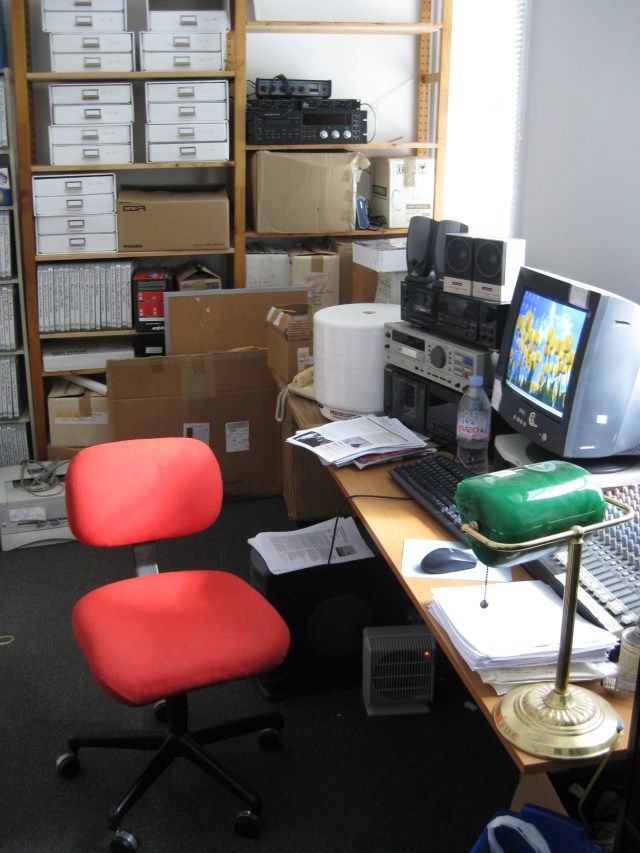
My temporary workplace at Echoes, in the archives room.

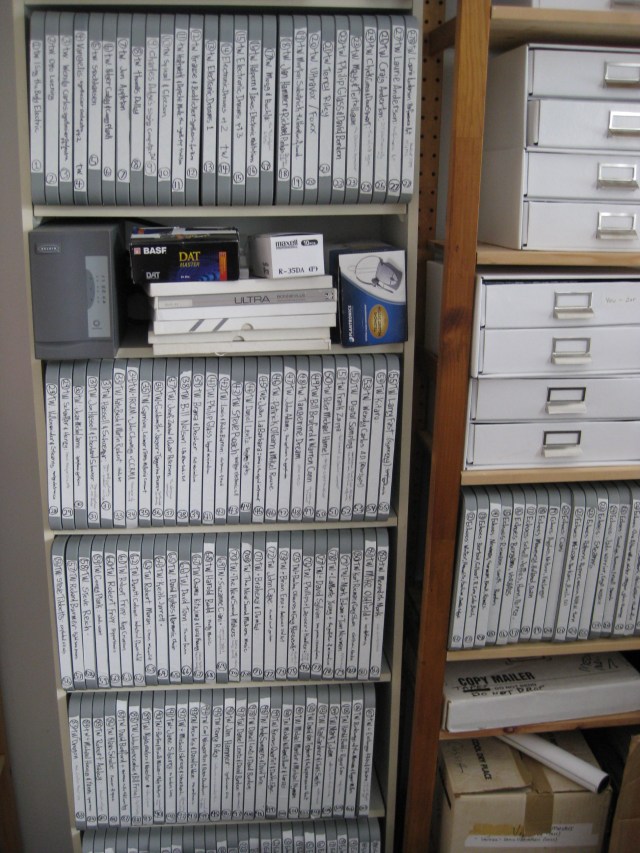
Reel-to-reel taped shows in the archives.

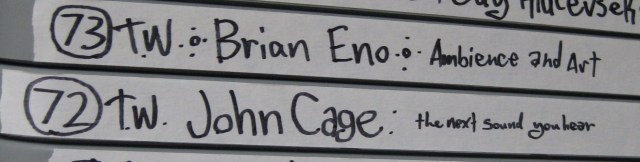
Some famous guests on the show:

Famous Electronic/Ambient/Experimental Composers Brian Eno and John Cage.

The legendary Frank Zappa.

Bill Bruford of King Crimson, Yes, UK, and many others.

Robert Fripp of King Crimson.

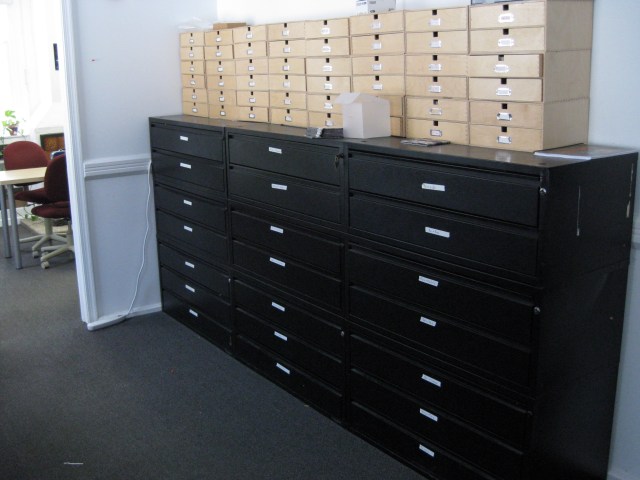
The CD album storage cabinets. Thousands of CD’s in here!

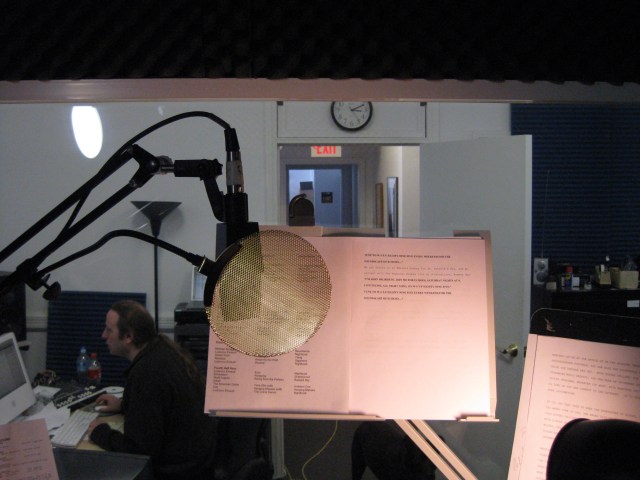
The recording booth.

Inside the booth:

Mr. Diliberto reads the script for each radio show here.

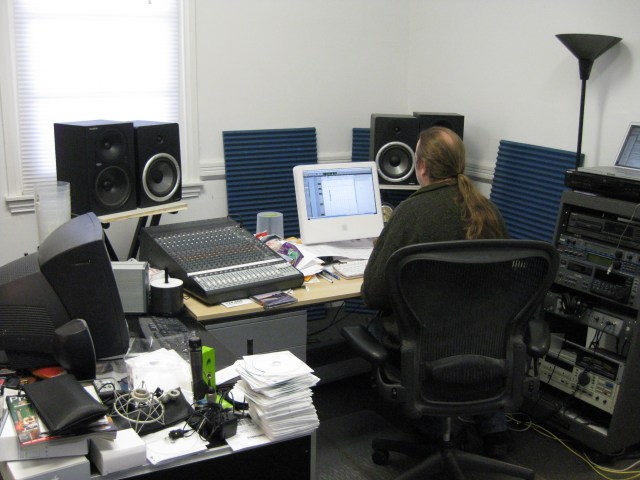
Jeff, the studio technician, works to assemble the next show next to the recording booth.

Last but certainly not least, MANNY!

The beloved studio dog and my best friend at the studio!

Where to Begin?

Wow.  Alright.  So.  I will start by apologizing for not being able to write more often, but our time here is so budgeted down, it is almost impossible to sit down at a computer and actually draft something with any content at all.  I hope that this will get easier in the second half of our trip, with greater access to computers, but we shall see.  I promise that I will try to write a massive post at the end summing everything up and including anything which I am sure to have missed or not had time to cover.

Ok.  So.  I have to say, and the past few days have brought this to life, that one of the greatest strengths of what we are doing is how many different people and viewpoints we are hearing from.  We have heard from an old Jewish Kibutsim (who had four sons and a husband  serve in the IDF), a bright young Arab-Israeli (and Arab with Israeli citizenship) lawyer, a Palestinian schoolteacher, and old holocaust survivor and artist, a Rabbi who has dedicated his life to advocating for human rights, an Israeli settler, a family of Greek Orthodox Christians who have been in Beit Sadour (right outside Bethlehem) for eight generations (who also happen to be the host family, from whose house I am writing), and several high school members of a traditional dance troupe.

Looking at the above list, it seems almost impossible to even begin to articulate all of the different ideas and viewpoints expressed by them (it would take me many hours, and I do eventually need to get to bed as we have an early start tomorrow).  Therefore, right now I will simply address what I see, as of right now, is the main most fundamental root of the problem, which can be glimpsed in various ways by what almost everybody had to say.  That root is this: the dehumanization of the “other side” and the quite high level of ignorance to all aspects of the issue by almost every party (of course, the less you know the easier it becomes to be sure you know what is right… the more I learn, the more I have to think and question, and the muddier the waters become.)

In any conflict there is dehumanization/ignorance of the “other side”, from the conquests of the Romans to the Civil Rights Movement to the current wars in Afghanistan and Iraq.  It is much easier to stand at a checkpoint as an Israeli soldier and causally refuse passage to anybody if all you know of the “other” is the memory you have as a child of watching a bus on the opposite side of the street explode and 20 people die; just as it is much easier to blow up that bus if all you see is the soldier who allowed your baby to die in your arms as you are trying to bring him to a hospital in Jerusalem by heartlessly refusing your pleas to let you through.  Ah, but wait: there in that very example you see the cycle; a cycle which only deepens the level of misunderstanding on either side and worsens the problem.

One thing is becoming clear to me: the more I learn, the better I understand how little it is I actually know, and how two weeks will only the a drop in the proverbial ocean of what there is to know, hear and see.  That said, read what is about to follow carefully, as it may well be the most important thing I write about this trip: at the risk of sounding clichéd, I lay on you one task; that task is to NOT simply accept things at face value.  Question everything you hear, because if you look closely enough you will find a contradiction and counterargument for everything, and it is only after sifting through all of the information available with the finest comb ever made that you will find the grain of sand that is your truth.

With that I shall leave you now, as I do need to sleep tonight.  Thank you for reading (I do understand that it is probably frustrating to hear me tell you to go out and get many viewpoints and then not have time to share the ones I have seen, but please give me time, I swear I will do what I can to fix this over the next week or two).  As always, any input (comments, questions, etc. etc. etc.) is greatly appreciated.

Assalamu alaikum (roughly: peace be with you)

More Midwifery

I returned to Port of Spain General Hospital today to complete my interview with Marcia Rollock. During this part of the interview, I asked questions that focused on the more personal side of Mrs. Rollock’s job. I was especially interested to learn about how she dealt with the emotional strains of helping a woman deliver. Mrs. Rollock opened up to me and told me about the first time she ever had complications during a birth, and about her first unsuccessful delivery. I became a bit apprehensive as I was introduced to these details of her life, but she assured me that, despite these negative details of her occupation, the joy at helping to deliver a new baby was always greater than the pain felt after losing one. We also spoke about being prepared to deliver at any time. Mrs. Rollock recalled with laughter at the time she had to conduct a home delivery at 2:00 in the morning and was so tired that she missed the street three times! All in all I have enjoyed speaking with Marcia, and I learned so much from her.

I was also able to speak with a nurse working at the hospital who was also attending the School of Midwifery. Emma Charles has been practicing nursing for 8 years now and after working on the maternity ward for 3 of those years, decided that she wanted to be one as well. Nurse Charles, along with two of her friends who are current practicing midwives, hope to open their own free clinic one day in their neighborhood of Laventille. Ms. Charles let me know that over the time she has been working on the maternity ward, assisting midwives and obstetricians, she has seen the number of mothers under the age of 18 increase drastically, and she hopes to assist these young ladies. She also wants to educate the upcoming generation and make contraception more available in her neighborhood to decrease the large number of young women getting pregnant. Ms. Charles told me about a program, made up of various nurses, midwives and obstetricians, that they have opened up in the hospital that actually teaches young, expecting mothers how to care for their children, creating a support system for these ladies. This program was Ms. Charles’ inspiration for wanting to open her own clinic, that will offer programs like this one to females that may not have access to the hospital. 

I am especially excited for tomorrow, however, for I will be accompanying Ms. Charles to one of these classes, for women in their third trimester. It also saddens me to know that many of the girls in these classes are my age, some even younger than me. I cannot imagine having a baby now, and can only imagine what a time this must be for these girls out here. But it makes me happy to know that there are programs like the one in the hospital that prepare these girls for the road ahead of them, and let them know that they are not alone.

Every day that I am here I see something else amazing and life altering that these midwives do for their communities. I am completely in awe of the wonderful things they are doing to support and assist women during such an emotionally and physically difficult time in their lives, pregnancy and then childbirth. I have no doubts now, whatsoever, that this is definitely a career that I want to pursue!

A shaky start to the second week

Hola,

On Friday we finished our last day of classes and received our certificates from the school. After checking out of the apartment, the five of us drove to the Santo Domingo, a beautiful beach on the coast. We stopped at a traditional restaurant on the way, where we ate typical Chilean food, and took myriad touristy pictures. We arrived at our host family’s house in Santo Domingo Friday afternoon, which proved to be one of the most beautiful places I have ever been to. Dark navy waves lazily slid onto the black sands of the beach, while just next door a man-made lagoon with crystal turquoise water was nestled into white sands. The view was absolutely spectacular.

We spent the evening having a barbeque with our host family and chatting about cultural differences between Chile and North America, quite the interesting conversation. After taking a nap, we all got ready to go out. Abby, Taylor, our host brother, his friends and I left to go to their favorite discotheque. We discovered that everything starts much later in Chile than in America. The discotheque was very fun, and very different from clubs at home. For one, everyone dances with a lot more respect for their bodies here.

At around 3:30 AM, the lights in the discotheque went out. Because the power had gone out early in the day at our host family’s house, we all assumed that it was normal. A few seconds later, however, the entire floor began to violently shake. With the surrounding darkness making it difficult to see, we thought that everyone in the club was jumping up and down because the music had stopped. When our eyes adjusted, we saw that no one was jumping, and everyone was screaming and running toward the door. I saw the disco ball crash to the floor, and then all of our instincts kicked in. We all made it outside, with a few cuts on our feet from the falling ceiling. From outside, we saw that the walls of the discotheque had begun to separate and the building was splitting open.

Amazingly, we reunited with all of our host brother’s friends and made it to the cars to get home. For some reason we had decided to park outside of the parking lot on the street before we had gone inside, a decision that proved crucially important now that the parking lot was a mess of people trying to get home. We made it back to the house rather quickly and saw that our entire host family and our friends, Liz, and Sarah were outside and completely fine. The house had a few broken objects, a lot of broken glass, a fallen chimney and some cracks, but it had survived very well.

Once everyone had made it back to the house (19 people total), we dragged mattresses and blankets outside and tried to sleep on the sidewalk in front of the house. More tremors shook the Earth throughout the night, but none compared to the first major one which was recorded as an 8.0 in Santo Domingo. When the sun rose, we assessed the damage to the house, cleaned up as best we could, and made plans to get back to Santiago to assess the damage there. There was no power, water, or gas in Santo Domingo, so there was no point in staying. We were also worried about a tsunami and further aftershocks. When we finally got a cell signal at around 7 am, we all emailed our parents from our friend’s blackberry to let them know we were fine.

The ride back to Santiago took over 4 hours, much longer than the ride there. We had to go a different way because the main bridge back to the city had been closed because of damage. There was a lot of damage along the road, mostly large cracks in the highway which proved a little scary to pass over. When we finally made it back, we found that our host family’s residence was almost completely intact. A few things had fallen over and part of the roof had fallen off but for the most part of the house was in great shape.

There were more tremors through the night, including one large one that had us all jumping out of bed to run outside until we were assured that it was safe to keep sleeping. In the morning, we went over to our host family’s grandmother’s house to help her clean up her apartment. She had not fared so well on the sixth floor. The windows surrounding her apartment had all shattered, most of the bookshelves had collapsed, there were broken possessions everywhere, the doors were falling off their hinges, and the ceiling and walls were cracking apart in many places. It was terrible to see but with everyone helping the clean up was not too bad.

Our entire group wanted to thank the Westtown community and all of our friends and family for their concern. I, for one, was completely shocked that so many people cared. We appreciate all of your prayers and hope that they will continue for those who are still suffering because of the Earthquake. While we are perfectly fine, many, many people were not as lucky. We were very fortunate to have been so well cared for by such wonderful people. The full implications of how this experience has and will impact my life are not clear to me yet, we are all still reflecting. I’m just happy that the sun is still shining, there are still no clouds, and my friends are all okay.

More Work at the School

On Friday we worked at the school from nine to three and for the majority of the day we acted as mentors to the children. The principal of the school would take three kids out of class at a time throughout the day to come and talk to us. Since there are three of us working there, we each would have some one on one time with the kids. The children that she would take out of class to talk to us are the ones who were missing a father figure or they were children who do not have much of a family at home. This was a hard exercise for me because it is difficult to have a serious conversation with a 7 year old. I was unsure of how to start the conversation, but once we got talking it went very well. I would ask the children what they want to be when they are older, and almost every single one said they wanted to be professional basketball player. When they said that I asked them about what they need to do to get there and they did not really know. I told them the most important thing to do is get good grade grades and work really hard. I also told them that they can’t fight with their friends all of the time and that they have to respect everyone. Most of the children really listened to what I had to say and they took the conversation to heart. Almost all of them would hug for me a while after the talk and that felt really good to know that what I said may have actually effected them. Since prior to this talk, I noticed that the some of the kids we talked to would get in a lot of fights at recess. Some of them did not really pay attention in class and would just talk all class to their friends. But as I was talking to them the biggest problem I noticed with the children was that they had no confidence or self-esteem. Which was really sad to hear them talk about, and the only thing I could do about that is talk them up for a while. It worked at the time, but once I leave I feel like things will go back to the way they were and it is sad because all of the kids are so exuberant and bright. This was a real growing experience for me and it made me stretch out of my comfort zone.

Yesterday we had the day off and we went to play basketball with the locals on the island. At the beginning they did not really like us being there, but by the end of the game we were joking with them and having a great time. I think they were hesitant towards us in the beginning because we are completely different from them in so many ways on the surface. But once we started talking to them and playing, it was like those differences just disappeared and it was as if we had known them for years. They invited us to come back to play on monday, which we will definitely do. Today we woke up and spackled the addition filling in all of the holes in the wood. That was difficult, but with three of us it went pretty fast. Once we finished that we had a lot to paint over and we had to put a third coat of paint in some place which was hard because a lot of those places were on the ceiling. But we have made great progress and only have to paint the floor yet. So far I am having a great time with all of these activities and I look forward to the week ahead. I’ll talk to all of you soon.

Thailand Love

I can’t even begin to explain my love for this country.  So far we have been in Thailand for four days and it already feels like a month (in a good way!).  After traveling in planes, waiting in airports, and riding in buses for about 30ish hours, we arrived at our hostel around one in the morningIt is a charming place with a guitar in the lobby and handpainted maps of Bangkok the walls.  

On the first day, we walked to Chinatown, Thailand’s oldest shopping districtOn the way there we passed through a neighborhood filled with carparts storesNow, this may sound boring, but it is my favorite part of Thailand so far.  It is filled with windy alleys filled with little shops with greasy dirty car parts literally overflowing into the streetsThe photographer in me instantly fell in love. 

Next, we went on a longboat tour of the canals around BangkokWe passed lines of houses on stilts with porches filled with bright clothes hung out to dryWe all agreed to buy houses on the canals when we retire and live togetherThere was a very romantic feeling to the simplicity of the housesNext, we walked to the Grand PalaceIt was very impressive, but a tad too sparkly for meThe buildings were completely covered in mirrors and lightsMy favorite part of it was the Temple of the Emerald BuddhaAfter walking around in the blinding light, it was very nice to step into the quiet shade of the templeThere was a very captivating calm that filled the templeThe Buddhas in the temple held their right hand up, as if telling those looking to pause and take a breath. 

Today, we took a longboat down the riverWe ate lunch at Pizza Hut!!  It was much fancier than any Pizza Hut I had ever seen in the statesAfter that, we walked around and soaked up the sights and smells of the streetWe relaxed at the hotel for the rest of the dayI am hoping to upload my pictures as soon as I finish organizing them.  

Stay posted! 

Tori 

Students in Chile

We have gotten word that all the Westtown School students in Chile for their Senior Projects are unharmed.  Our thoughts and prayers go out to all those affected by the quake.

We will keep you posted as we receive information.  Thank you for your care and concern.

Connection at a Checkpoint

I must confess that I am finding it increasingly difficult to write about my experiences in this place. What I have seen, heard, and felt here is too much–at least at this point–for me to even sum up in my head, much less in writing. There is so much going on here. So many layers of this conflict, of this land, of these people. Seems like the more I learn about it, the more confusing it gets, and the less of it I understand overall. It’s not an uncommon feeling. From what I have heard, plenty of folks around here are confused, especially those who’ve spent their whole lives here. It’s a perplexing place to live in.

With that said, I think I am going to change the format of this blog a bit. Instead of posting a dry account of what exactly we have been doing–who we have been talking to, where we’ve been going–I think it would be more interesting, for you and for me, if I were to post a series of reflections on what I’ve been experiencing. Less emphasis on the who, what, when, and where, and more emphasis on what I’ve been feeling and thinking about all of this. I mean, we’ve been doing a lot every day, and packing a lot into our schedule, so to describe all of it would take up the whole entry. And since I don’t have a lot of time in which to write these things, we’ll really be getting the most bang for our buck if we do things this way. Sound good? Good.

So let’s just go from there.

Yesterday, we visited a checkpoint outside Barta’a, a Palestinian village that has been literally divided by the conflict: the Separation Fence (so called because in this area of Israel, it really is more of a fence than a wall) runs right through the town, thus splitting it into East Barta’a and West Barta’a. To add to the turmoil, a Jewish settlement has been constructed near West Barta’a.

We reach the fairly deserted checkpoint, get out of our tour bus, and, following the lead of our intrepid tour guide, British-born journalist Lydia Aisenberg (look her up!), approach a couple of Palestinian men hanging around outside. Turns out they’re taxi drivers–well, unregistered taxi drivers, who charge 5 shekel a head to drive people from the checkpoint to West Barta’a. Most Palestinians must go through checkpoints on foot, which means walking several miles if they just want to go from East to West Barta’a, and there are many locals who work in one village and live in the other. Add the fact that merely passing through a checkpoint at peak times can take hours, and you’ll see how a taxi service going between the checkpoint and the town is a necessity.

Lydia continues her conversation with the taxi drivers–they speak to her in Hebrew, and she translates to us in English. Despite the fact that they’ve never met any of us before, they’re easygoing and quite willing to share their experiences with us.

I notice that while this exchange is occurring, the white metal gate leading into the checkpoint’s security office opens, and a man appears. He is dressed completely in black, his right hand casually indexing the submachine gun that hangs at his side. He stares at us for a while; then the gate closes again, and he’s gone.

After speaking to the taxi drivers, another Palestinian man is introduced to us. He is more smartly dressed than the others, and can speak English. He tells us that he is an English teacher. In the ensuing conversation, we learn that although he earns a rather pitiful salary working in Barta’a and could easily earn twice as much were he to emigrate to Europe or North America, he never wishes to leave his native Palestine. Why? we ask. It’s simple, he replies: This is his home.

It’s time to go, and we thank the Palestinian men. Just as we’re muttering shukran and turning to go back to our bus, we hear the English teacher speak  up. “I would like to shake hands with all of you,” he says. One by one, we oblige. And as I extend my arm towards this man and grasp his hand, I feel something within me shift. With the simple act of touching his hand, of looking into his eyes, I am suddenly connected to this place.

That connection has been growing stronger and stronger since I first set foot on Israeli soil. Already, after only four days here, it has burrowed its way deep into my soul. In all honesty, I can’t see it leaving anytime soon.

It’s thundering mightily here in northern Israel. Maybe it’s the voice of God. Or maybe just weather systems; who can really tell? Anyway, that’s about all I have time for tonight. I hope you enjoyed this little snapshot. With any luck, I’ll be able to provide you with many more in the days to come.

(By the way, please do not think that we are experiencing a one-sided view of things in any way, shape, or form here. Quite to the contrary–it seems like every new person we meet has a different point of view on this whole issue, at times completely contradictory to someone we spoke to elsewhere. Hence all the confusion I have been experiencing.)

Shalom,

Laura