They’re Hanging WHAT from a Balloon?

Telescopes that search the skies for wavelengths that are too delicate to pass through our atmosphere have to be hoisted up into the air with a giant balloon. The telescopes are mainly made out of metal, so to keep one airborne, balloons the size of football stadiums or bigger are needed. You heard that right: not a football field — a football stadium. BLAST is a telescope I worked with today which will use this balloon mechanism when it observes the universe around us. Today I met with two students who are building the telescope, complete with reaction wheels and motors to allow the telescope to turn and state of the art optics mechanisms to filter light. The frame is about the size of a minivan, and is made of white metal pipes which will hold a larger metal frame, a carbon fiber mirror, and a gigantic cryostat filled with liquid helium, cooled down to below its boiling point near absolute zero. Nate, a graduate student, explained the mechanisms to me as I walked around in wonder. The sheer number of things that had to go exactly right for all the data to be collected and all the systems to function properly was mind-boggling. In addition, most of the equipment needed is not built commercially, so the graduate students have to build it all themselves.

Imagine building a machine including liquid helium, pulse pumps, and yards of spiderweb-thin wire to make a machine that cools down an array of specially designed chips to feed out into a complex computer system you have to code yourself. Doesn’t sound so easy! But this is what the students must do. They are motivated by their desire to search the skies, and I can feel it too, even through the frustration Sara and Simon feel as they sift through mountains of data and run endless tests in order to find the problem with their machine.

Since yesterday, the array in the cryostat was running a little colder — a good sign after the 1o0 milliKelvin discrepancy of the day before. However, the gap wasn’t big enough, and the graphs the computer kept outputting from the complicated programming tests Sara was running were not looking like the uniform, smooth curves she was looking for. I cannot begin to understand how they kept themselves so calm, how they worked through the frustration they must have been feeling at the circumstances there had been no way to foresee. I admired their work today greatly — I can only think how discouraged and frustrated I would be in their situation. When Brian, their collaborator on the Green Bank Telescope, arrived they explained the situation to him and he sat down to work. While some tests were running, Sara also explained to me the science and concepts behind their experiment, including how changes in the Cosmic Microwave Background (leftover radiation from the Big Bang) can show us how energetic events are in the universe, and how the inflation period of the Big Bang happened in thousandths of thousandths of seconds to set the stage for cosmological formations.

Here is a picture of the CMB:
Planck_CMB

It was incredibly interesting and complicated. It is unfathomable and crazy — the way that we can look back in time using light that is only now getting to us from the far reaches of the universe during the early stages of the universe may be the closest we ever get to time travel. But that doesn’t mean we aren’t going to try, and the UPenn lab is the perfect place to begin to unravel the mysteries of the universe.
A Stranger in a Strange New Place: A Jewish Right of Passage

It’s 12 am, the end of my second day in Tel Aviv, Israel.  I just finished writing 15 pages in my journal and have yet to cover today… so yes, a lot has happened, and yes, I am exhausted.  The thing they don’t tell you about traveling is how challenging it is, especially alone.  At Westtown I can go into a friends room, but here I am my only support.  Thankfully I have wifi and can keep in touch with my friends, but in the end when I turn off my phone it is just me here.  I still try to dive into every situation with an open mind and have learned so much already.


The El Al flight was easy and, luckily, I slept through most of the chaos.  I have never been on a plane where people walk around so much.  At day brake, the Orthodox Jews stood in the aisle to do the Amidah (morning prayers) while crew maneuvered around passing out glatt kosher breakfasts and children ran around.


My first day in Tel Aviv was warm like the sun and cool as the sea breeze.  I had a wonderful roof-garden lunch with Nurid (with whom I am staying) and went out that night with some young Israelis.  The people here are so friendly and open, but they are very intense.  Everyone has served in the military and there is a sense of urgency about the impermanence of life.


Today I went to the Pelmach Museum and met young visionaries who work to improve the lives of Ethiopians and Palestinians. Tonight I had a very interesting talk with Avishay about Israeli politics and it is just as, if not more complicated than American politics.  I feel like this trip is a “right of passage” for a Jew because I am facing the contradictions of a Jewish state.  It is a state founded in the name of freedom, to be a refuge for the suffering, but has not fulfilled its promise to all its people.


I am safe and am in good hands.  My mind is expanding!  Part of me wants to run away and return to the safety of my own bed and the other part is filled with the adrenaline of the adventure.  Tomorrow, I am of with Amos to tour Haifa and Akko and then I will spend the Sabbath at a Kibbutz.


Until then, much love,

Hannah


Day 2 in San Francisco

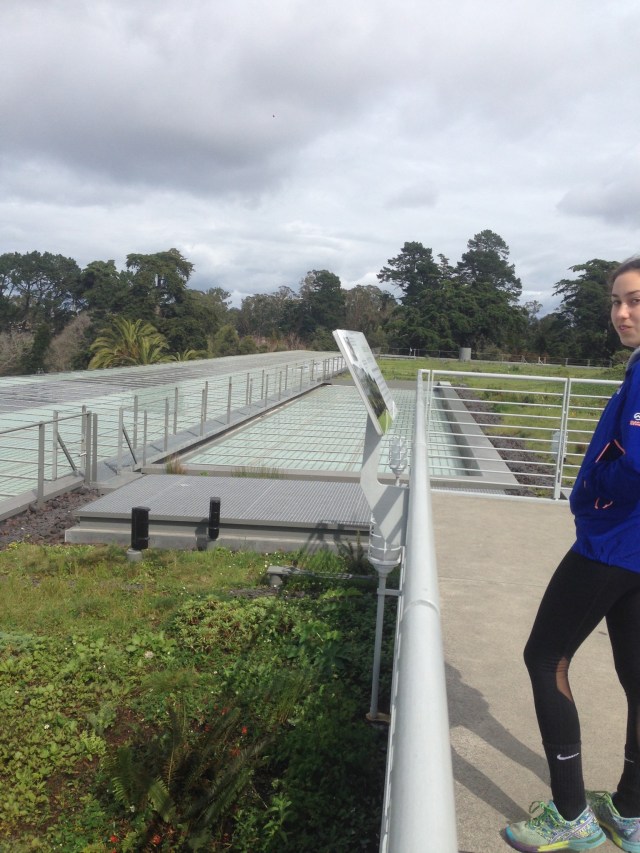
With no morning obligations, Lily and I set out for a run along the cloudy bay. Although this sounds relaxing, the run up Lombard Street was absolutely terrible (both because it was hard and because tourists were watching us sweat). Back at the apartment, we decided to set of for the California Academy of Science Museum. We walked through exhibits on rainforests, Snakes, Earthquakes, and “The Colors of Life”, which showcased the purposes behind camouflages and reflections. Fun fact of the trip: you can tell how big a salmon population was each year by looking at the amount of nitrogen in each tree ring. Beyond animal science, we experienced the building science behind CAS Museum. We took an elevator up to their living roof, which showcased six of San Francisco’s most resilient flower and grass species. The living roof also served as a natural thermal balancing system. The thick dirt layers help to keep the building hot in the winter, and the plants block the roof from attracting heat in the summer.

IMG_6420.jpgIMG_6421.jpgAfter CAS, we made our way to a casual coffee shop interview with Pete Kauhanen, who works with the SF Estuary Institute, where we’ll be visiting later in the week. He talked about his initiative, Green Plan-It, which maps areas by bio retention level. What interested me most, however, was not his work San Francisco, but in Australia. Pete lived with a semi-nomadic tribe that uses a method called “fire-stick farming” to clear land of harmful underbrush for hunting. It’s the older women of the tribe who have the responsibilities of fire starting and hunting, mostly for lizards. These small, controlled fires help prevent raging wildfires that would be prevalent if not for this strategy. In the past these tribes were pushed away, but recent initiatives by the Australian government have included the co-management of national land with indigenous tribes. This symbiotic relationship is not only much more respectful to the tribes, but also prevents wildfires and helps to maintain park safety and health. The controlled fires also encourage biodiversity by creating sub-environments within a giant area, which are differentiated by the levels of foliage growth after a burn. This example shows us how we can benefit socially, environmentally, and even economically (less recourses went to massive fire forces), when we work cohesively and respectfully with indigenous people. Pete, Lily, and I discussed possibilities for relationships like these with the National Park Service in the U.S, but failed to draw any conclusions on the potential. Pete said that the tribe he lived in is being featured on the first episode of Cook, a new show on Netflix that Lily and I are about to watch. Goodnight Blog!


-Molly

Computer Science Intern- Day 1

Today I began my first day as a computer science intern at IONX here in West Chester. Today I was getting setup with my new project and learning what my new project is. I had a few meetings to begin the day that taught me what IONX, and my boss Matt, wants from me. This picture is from one of my meetings where I was shown what I will be using to work on my project.

20160307_095422I learned only 10 minutes into the workday that Matt will be in California for the entire week, so I will not be working with him for now. I began my actual workday messing around with the types of code statements that I will be using, called queries, which allow me to analyze data. The project that I have been assigned is to analyze data from a couple of locations across the United States that IONX is using to test its new sensor system. I will be analyzing the data that the sensors give us and developing code, or queries, that can analyze the data quickly for any errors. Using computer programs to analyze the data is much quicker and easier than manually combing through thousands of entries to find errors. Today I began writing the queries with my coworker, Trevor. Trevor is the youngest person at IONX at only 23 years old. He and I are working well together where we have been talking a lot about other interests that we both share. He is teaching me some of the necessary steps needed to develop programs. I look forward to developing my computer coding skills with Trevor.
Houston, We Have a Problem

Murphy’s Law: Anything that can go wrong, will go wrong. Brilliant people have spent years of their lives working on cutting-edge technology, and unforeseen consequences can mean much more time spent on these experiments.

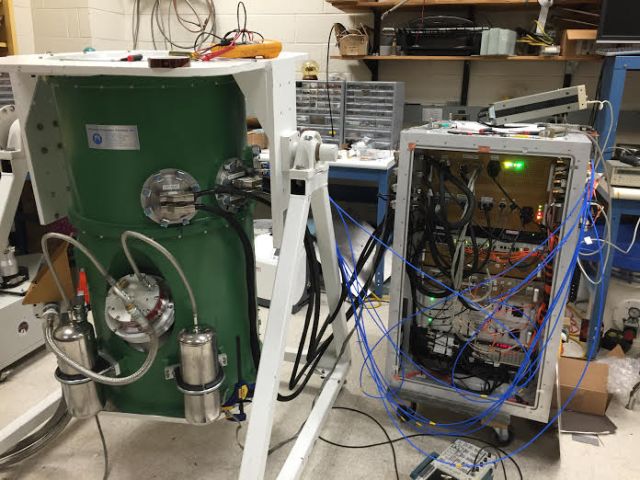
Simon’s worried face was the first thing I saw when I walked into the lab today. He was staring at the cryostat, a large, green canister, which was emitting a rhythmical squeaking noise as the pumps strained to cool down the inner lenses.

f7b9e34f-2fda-4df3-9e0c-11f4ae95f832

“It’s running 100 milliKelvin above where it should be right now. We’ve had it cooling for much longer than expected, and this is worrisome.”

0.1 Kelvin above where the temperature should be, within fractions of absolute zero, doesn’t seem like much of a big deal. For this project, however, it is devastating. The whole project depends on the temperature being constant and in a certain range. Without the correct temperature, the measure of heat using changes in resistance falls apart, as does the superconducting nature of the wires. Without the correct temperature, bright, energetic events in the universe would not even register.

Sara and Simon sat by the computer, looking at complicated, squiggly graphs and deciphering their secret meanings, gaining data from them when all I saw was a strange figure reminiscent of a Jackson Pollock painting. They plugged numbers into a code and the computer chugged out countless graphs. Trying to pinpoint the exact correct ways to make the cryostat function was proving to be very difficult. Hopefully, there is nothing wrong inside the cryostat itself, which would mean a few more days of work opening it back up, fixing it, closing it again, and cooling it down. As Simon and Sara work hard to fix the problem, I will be working on a balloon-borne telescope project tomorrow called BLAST — interesting stories to come on that!

A Great Weekend for The Metal Moose

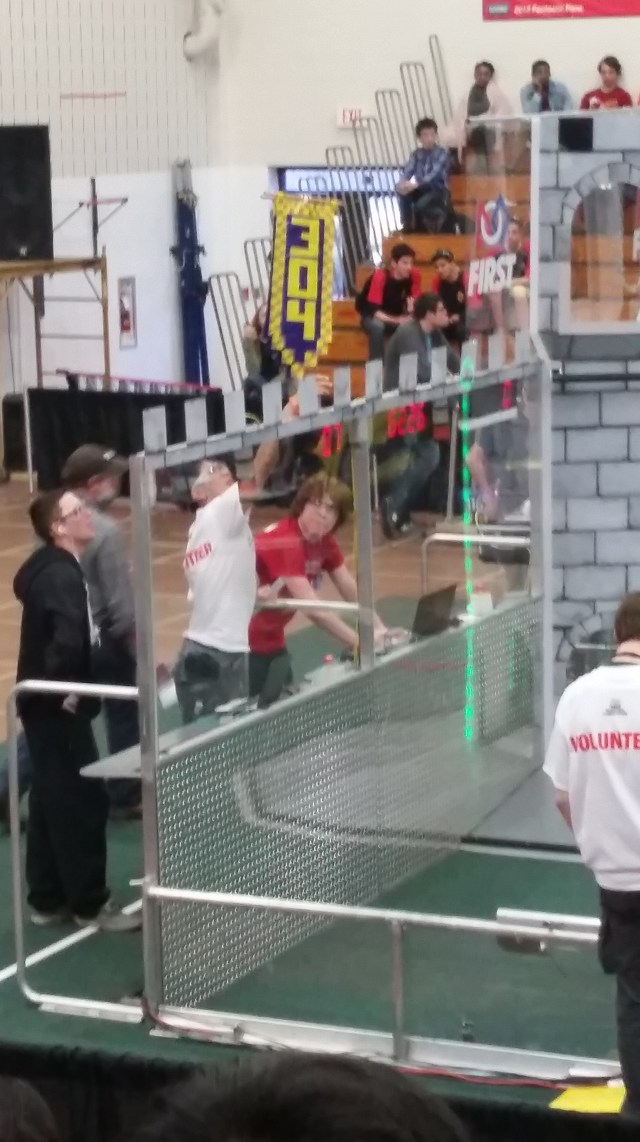
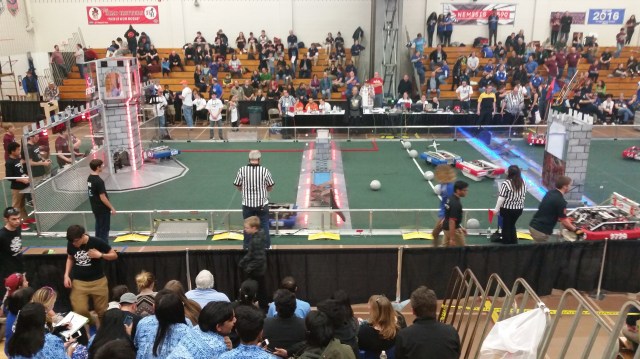
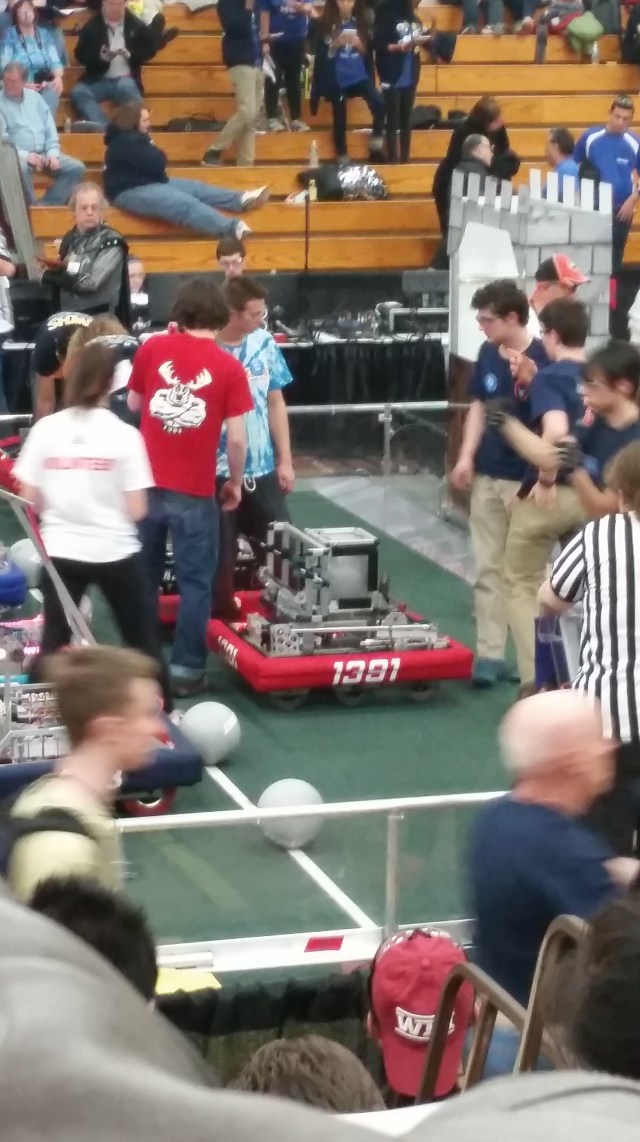
I mentioned in my first post that I really wanted to celebrate how amazing FIRST Robotics is. This weekend I took a break from my work to go to our first event of the season. We started our Saturday with a motor burning out during practice matches. Still, we quickly recovered and started our weekend with some good scores.

20160305_183650

Near the end of day one we were ranked 2nd. At the end of day 2 we were ranked 6th before playoff alliance selection. In the end, we finished in 5th and won the Creativity Award for our design.

20160305_171917

Our next event is in 2 weeks and then the home event at Westtown April 1-3.

I can’t wait to do more work on my quilt and dive into the history of this wonderful sport.

20160305_171906

A Jo-Ann’s Journey

Friday night I went to one of my favorite places: Jo-Ann Fabrics

If you’ve never entered one of these stores it’s a candy store for the serious arts and crafts. I say serious because this is no Michael’s or A.C.Moore. This is the grown up version of craft stores where everyone’s super-talented aunt or neighbor disappears to every so often and emerges with what seems to be another quilt already half-done.

So how does fabric shopping work? Well, this is the quilting section. There are many other sections in Jo-Ann’s, but different types of fabrics work for different purposes. There are upholstery, apparel, stretch, flannel, and leather to name a few. Most quilting fabric is thin cotton dyed or printed with a color or pattern. There are generally three options for buying quilting fabrics.

  1. Fabric Quarters (Which Were on Sale!) – These are quarter yards of fabric sold individually. This is good for getting a lot of different small quantities. While there are less overall options versus buying from the bolt, they make the process a lot easier.

20160304_184047

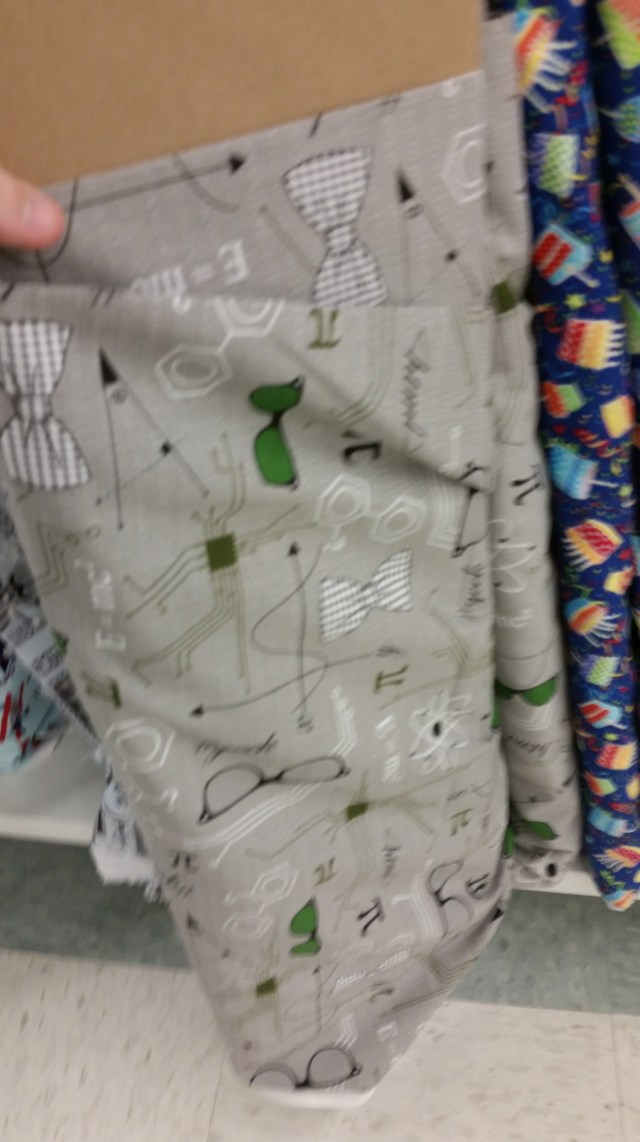
2. Bolt – As I mentioned before, this way can have more options but is more complicated. The bolts are the fabrics wrapped around cardboard. You can get larger quantities of these and they are sold by the yards. ( I like the one below for the back, what do you think?) You get these hand-cut by the staff, which can take a while if there’s a line. You have to be careful when buying these because you may not know the width, which can change, and because the price can add up pretty quick.

20160304_18382520160304_185225

3. Remnants – I don’t have a picture of this but I love remnants. These are “created” when a bolt runs out with around a yard or less or if a fabric doesn’t sell. These are in small bins and are sold at the unit price.

I bought a…moderate amount of fabric along with some extra threads and supplies and set up my station on G2. That was Friday.

Galactic Nuclei

The first thing I noticed when I walked into the lab was how loud it was. There was an intense humming coming from a large metal crate, and a ventilation that created an additional whooshing noise. I almost had to shout to be heard over the noise as I said hello to the people with whom I would be working on MUSTANG-2, a cosmological project in the department of Astrophysics at University of Pennsylvania. The people in the lab were my sponsor, Sara S., a tall, friendly, and confident graduate student, and Simon, a kind, soft-spoken researcher who visited UPenn from England and met his wife. The two were managing the huge crate of electronics, fitted with five different computers, and a gigantic, homemade cryostat (to cool materials down to within fractions of absolute zero). Sara introduced me to the general idea of the materials they were using, and then sat down to solder some pieces together on the lens of the telescope. As she worked, she told me about the goal of the project.

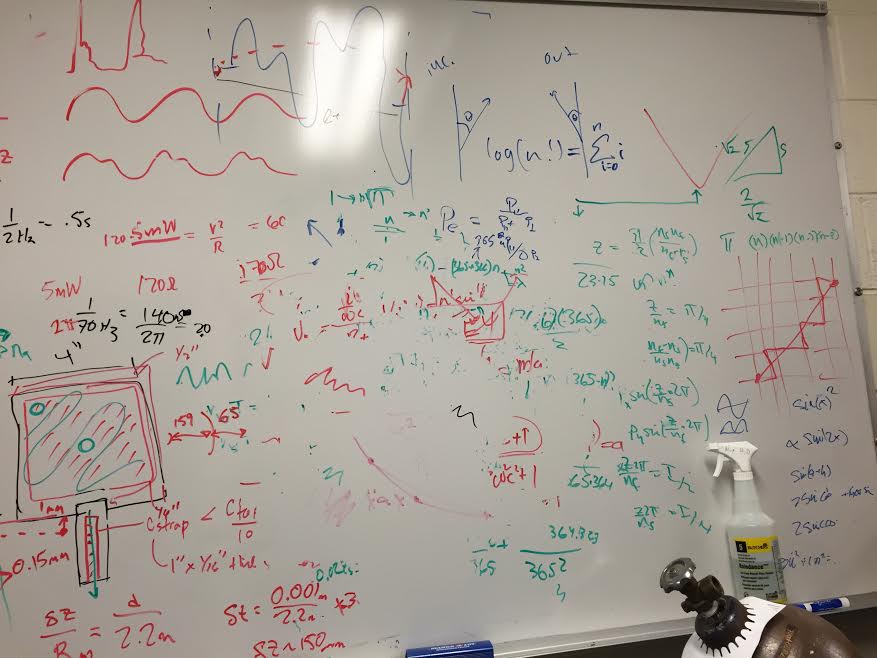
The types of things one would find in the UPenn Experimental Cosmology lab

“The metal crate has four different computers that output signals from our detectors to the main computer where we read the data. Our detectors are only made in a few places in the world, and we have one of the highest resolutions available, with many more pixels than most telescopes. We’re going to bring this apparatus down to a gigantic telescope in Virginia, where light will bounce off a large mirror and focus onto our lens, which will be cooled down to millionths of a Kelvin away from absolute zero. The signals will travel along the wires, which, due to their coldness, will become superconducting. The infrared rays we measure will be registered on a series of resistors, which will change in resistance rapidly with changes in temperature. Then, we can create what is essentially a heat map of galaxies in the universe in order to learn how they were formed and what they’re doing now.”

Wow.

Thanks to T. Larry’s successful efforts to control and teach my Physics 4 class, I understood at least a fraction of what Sara was trying to tell me.

“So, basically, we’re making a heat map?” I asked timidly.

“Yep!” she exclaimed with a smile. “And you get to help load the lenses into the cryostat!” A big responsibility for me, when each detector is worth thousands and the whole project has taken years of hard work. I sure didn’t want to drop anything!

While Sara continued to solder, Simon pulled one computer out of the crate, telling me it wasn’t ventilating properly. The resistance of the apparatus they had was higher than expected, which meant a higher base voltage had to be run through the circuitry in order to maintain the desired resistance, right on the edge of superconductivity. As a result, the computer and the crate were overheating, and something had to be done. We opened up the computer, which was sealed with metal tape to keep the signals from interfering with any technology, and took a look at the circuitry.

“See those parts right there?” asked Simon, pointing to a few bits of the circuit smaller than the nail on my pinky finger. “For seven months those didn’t work, until we dabbed a drop of silver paint under them. Seven months of failed work just to discover a unit the size of the head of a pin was not grounded correctly.” That floored me. I couldn’t even imagine working on something for seven months, only to realize one tiny thing was the reason I couldn’t look at the stars! Keeping the issue of grounding in mind, the problem was easily solved and the ventilation issue was resolved.

“I’m done!” said Sara when she finished soldering the central lens of the project together. She carefully carried it over to the cryostat, and I watched with bated breath, knowing it was the result of tens of thousands of dollars and years of work and research. We cleaned the parts that had to fit together with alcohol in order to create a vacuum seal, flipped the heavy cryostat over. The lens then went in the top, and had to be screwed in carefully. After Sara and I completed that, we put tape around the edges to ensure there were no light leaks hat would affect the readings. Then, three more lenses, each more delicate than the last, had to be installed, screwed in, and taped. Finally, a lid was placed on the top and screwed in to ensure a vacuum seal and no light leaks. The cryostat was loaded. We flipped it back over and admired the work. It was ready to be transported to Virginia, where it would be cooled using an isotope of Helium and then hung from the ceiling to absorb the light focused on the mirror. Then, we could look at the stars! It was incredible to be able to help install something that was state-of-the-art, something technologically advanced and important for the understanding of our universe. The theory I have learned in class on a microscopic scale was playing out in front of my eyes on a large scale, and I was able to take part in it! I could feel the excitement filling me as I looked around the room, realizing I could be a part of something like this, that I could help to explore worlds we know nothing about. I am excited when I look forwards to next week and the work I will do next, analyzing data and trying to understand the mysterious bodies that make up our universe. Stay tuned for more updates on the galactic nuclei heat map!

Creative Writing

Hey, everyone! Just got home after a long train ride, and I’m excited to really kick off my creative writing-centered senior project! As some of you may know, writing is a passion of mine, but between cocurricular sports, club meetings, and academics I unfortunately can’t often find the time to do it at school. I’m excited to have the opportunity to write intensively over these next few weeks, though, and hopefully I’ll produce enough good work to be able to submit some for publication! I’ve been brainstorming ideas for a few months now, and I think I have a couple good ones I could turn into poems, short stories, or maybe even something else…

Anyway, I’m curious to see what I come up with over the next few days! This is a time for me to experiment and move beyond my  comfort zones, and I hope I grow as a writer over the duration of my senior project. Check back in often to see my progress!

-Caroline


Israel: Goodbye “peace,” hello “shalom”

I can’t believe I’m actually starting my Senior Project. I’ve been planning trips in my mind since freshman year- and now I’m finally off.


For the past few weeks, people have been asking me what I’m doing. “I’m going to Israel,” I say. “But not on the school trip, I’m going by myself.” This is often surprising, so I elaborate, “I’m studying water in the Negev Desert, working with Jewish feminists, meeting Bedouin teens…” and that’s not even the half of it. I am going to be traveling the country meeting, living, and working with many Israelis from all different realms of life.


Tomorrow, my trip starts and I will arrive in Tel Aviv and meet Avishay. Now, however, there is much packing and preparing to do!


I will be posting all about my trip, so check back in often.


Shalom