After a quick breakfast with the group we walked all together to the base of the sun temple ruins. We met up with a local guide and he led us up the ruins, explaining Incan history along the way. Every activity we do here seems to involve ‘a short hike up the mountain,’ so I often feel a little winded, but we are trying to avoid altitude sickness as best we can by staying hydrated and drinking coca tea (a tea made of coca leaves that supposedly helps prevent this sickness).
The Inca engineering is incredible. The steps we climbed up were granite rocks about 2’ wide by 4’ deep, and very thick. I can’t completely wrap my head around how these huge rocks were transported. The ancient people harvested them from the top of a neighboring mountain, and then used timber, ramps, animals, and their own physical strength to haul them up to a very high point on the mountain of the sun temple. I wonder how many years and people it took to do this. There is evidence here at the sun temple of the Spanish invasion because some rocks were abandoned on the ramp on the way to the temple. How disappointing it must have been to not be able to finish.
The temple walls are built like a giant puzzle—each fitting into the other with such precision that you could not fit a sheet of paper in-between them. I tried to soak up as much history and knowledge from these people as possible. The architecture here is amazing. We learned that trapezoid-shaped doors and windows are a distinctive feature of Incan architecture and this is an easy way of differentiating ruins.
The placement of these structures also amazes me. The Incans looked at the nature around them and the shapes of the mountain and then built in a way that incorporated the earth. Unlike in today’s society, where we destroy nature and build up our own towers, the Incans embraced nature and trusted its guidance for their architecture. They seemed to have had no problems with landslides, earthquakes, or erosion; after all, mountains have been standing for quite a long time…
As I settled into my peruvian lifestyle, I became very aware that the trip I was on was not meant to make you feel settled (in the best way possible). On Tuesday March 4th, after another great breakfast (the food was always fantastic), we met our host families outside of our hotel rooms, and they helped us carry our things a few blocks away to their homes, which were spread out all over the small town. Our group had been divided into groups of 2 or 3 and each assigned to a family. I was lucky enough to be roommates with Newell! I had become increasingly more nervous to meet the family, mostly because out of all the groups, Newell and I had the least amount of spanish experience; me having none, and Newell being in Spanish 2. Leaving the hotel was completely throwing me out of my comfort zone and I have to admit, I was scared. Babina, my host mother, greeted us with a big kiss on the cheek and Poncho, my host father, a friendly hug. Their house was very cute. Newell and I shared a room with two very comfortable beds. Most of the houses in Ollantaytambo had an outdoor center. In my house, there was an outdoor courtyard with all of the room surrounding it, meaning that all of the doors to each room you had to go outside to enter. I didn’t understand much of what they were saying, so I just smiled and nodded. They sensed how tense I was and offered to play UNO. Once my host siblings, Yessica and Yack came home from school, Newell and I soon learned that UNO was a household favorite. We played for 2 full hours! I wrote in my journal that night, “I am starting to realize that their family is so similar to what we know as a family, along with their traditions. I am beginning to understand the uniqueness of the experience I am having. Even though I cannot understand almost all of what they are saying, to be able to sit and observe is the most influential thing. It is so cool to realize that they are just a small loving family living in this big world, and I already know that I will think of them when I go back home.”
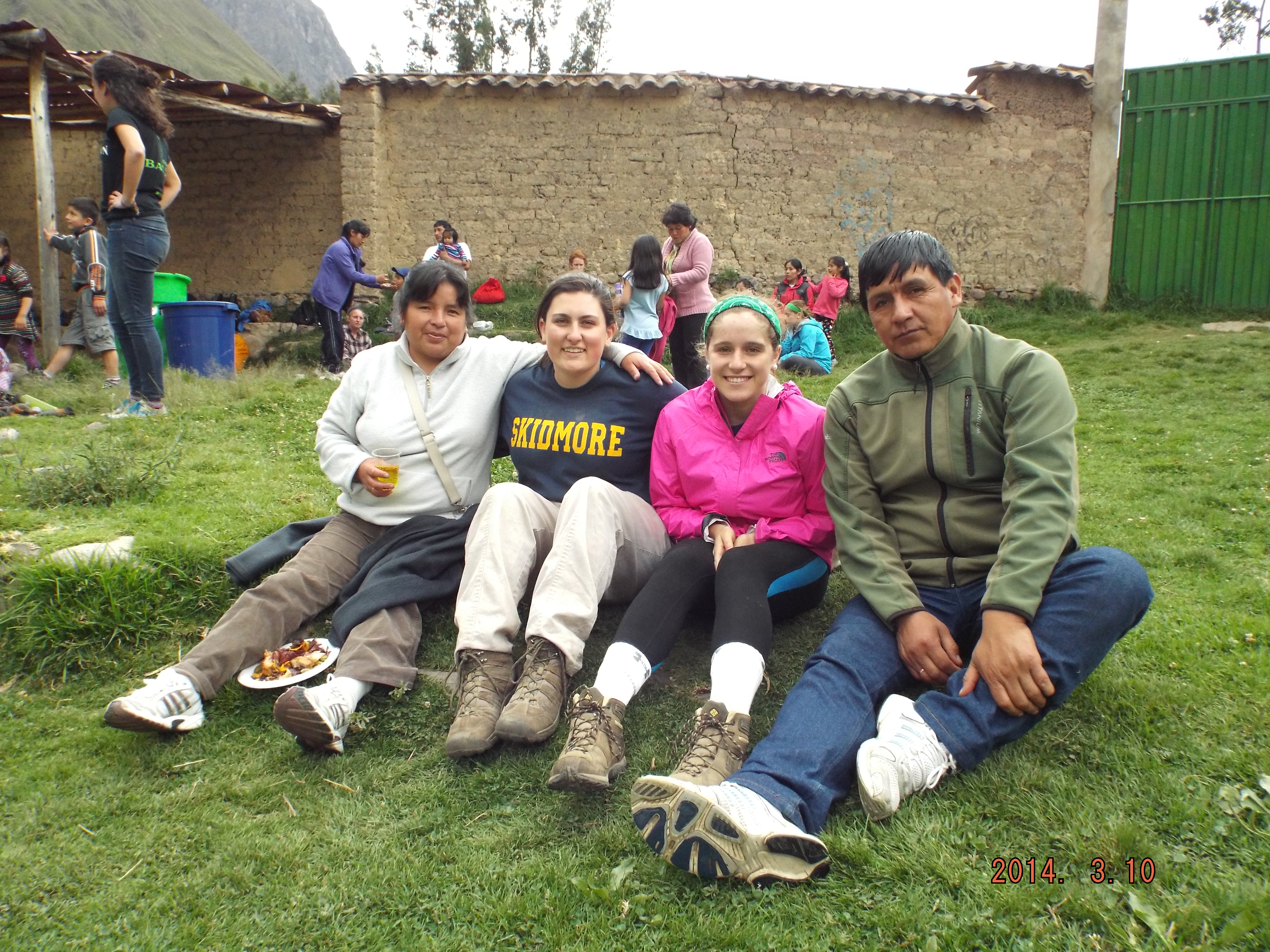
Here is picture of the happy family who, although we had trouble bonding with, grew increasingly more comfortable with and accustomed to living with. I realized over my 6 days with Poncho and Babina, that I never really felt in my comfort zone, but I learned so much about life of the people in Ollantaytambo. The most important thing I took away from them was that people share and spread love all around the world no matter the circumstance, level of education of financial situation. I feel truely bless to be pushed into this opportunity where I would take so much. Even though we were maybe not the greatest match for each other, I am really thankful they were able to open up their home and open up my eyes to their lifestyle.
Over the next few days, we started our service project. It was very exciting! The town of Ollantaytambo had just finished a brand new high school. It was beautiful, and everyone was so excited for the opening day! Our task was to help build a wall on the back side of the school. Over the next couple of days we would unload 1,000 cinder blocks from the back of a truck, move 2,000 cinder blocks from the front of school to the back of the school where the wall was being built, carry dirt, cement, and rocks and get very dirty. It was quite the task. Our group had moments of high tension, laughter, arguments and collaboration. My one wish for the trip would be that we could have made more of an impact on the wall, but unfortunately because of the time consuming labor we didn’t get to see it finished. Overall it was a wonderful experience because we all really came together as a group.
Here is a picture of the first opening day of school on our final day of service! It was so great seeing how excited the kids were to start classes!
The most influential experience over these few days was the Weaving Community. On March 6th, after a long morning of service, we boarded a little bus and took a very bumpy, very scary ride up the side of a mountain to the community. It was incredible. The women were seated, all in traditional dress, working very hard on their pieces. We all gathered and watched them, snapping pictures and listening to our guide explain their lifestyle to us. They used all natural dye’s and carefully spun the llama fur into beautiful yarn. We were each paired up with one of them, and they helped us weave our own bracelets! It was so cool. The woman I worked with was so sweet. I had no idea what she said at all, but I just kept telling her things about our trip and how great things were in english even though I knew she didn’t understand either. She had a great smile and it was great working with her.
After we finished weaving our bracelets, I thanked the woman I was working with and we walked through cluster of houses where they lived. We went inside a house and got to look around. It was then that I realized that what I was seeing was unbelievable poverty. The house was hardly big enough for a few people, and had no furniture. There were no windows or chimneys, and the people often had respiration issues. There was no running water. It was hard to understand and accept that people were living in these conditions. I realized that these women put on their traditional dress and work hard on their beautiful creations for people like me and the rest of the group, who have come to learn about peruvian culture. It surprised me that people with such unique and incredible talents are forced to live in such poverty. But at night, when they go back to their houses, they have to live in these conditions, without a bed, water, or even fresh air. I was truly taken aback, and humbled to have met such simplistic happy people who live with so little, and wish so badly that I single handedly could have helped them in that moment.
Here is a picture of the women, seated, working tirelessly on their wonderful creations.This is a woman stirring a pot of yarn. She has just added the natural dye which she extracted from a plant and is now mixing it into the pot.
Everyday comes with its new share of adventures, experiences, and ways of stretching myself out of my comfort zone. On the morning of the 4th we anxiously met after breakfast to go through a question and answer session about moving in with our host families. Each of us was paired with either one or two people to live with local families for the week. Living with these families meant eating each meal with them, helping them around the house, and learning about their way of living. After our quick Q+A, we finally were able to meet our family. I was living with Amelia, who did not speak Spanish. I am in level 4 and traveled to Spain last year with Westtown so my Spanish is pretty good but can always be improved. We were greeted with a kind looking women holding a little baby: Anita the mother and Luisiana the daughter, and an older girl around our age named Shura. They both greeted us with kisses on the cheek and immediately helped us in lugging our huge suitcases to their house, 10 minutes down the road. On the way to the house we made small talk, with the conversation a little awkward at first but eventually we found common ground in topics like siblings, music, food, and everything in between. The house, which consisted of a little courtyard and scattered rooms, was adorable and sat on a well-known street named La Calle de Cien Ventanas (the street of one hundred windows). Continue reading “Homestays, the Weaving Community, and Service”→
For my senior project I will be interning at People’s Light and Theater in Malvern, PA. During my time there the theater will be getting ready to open a new show called Dear Elizabeth. The play follows the letters of the poets and best friends Elizabeth Bishop and Robert Lowell. It is a subtle story of friendship, poetry, and two separate lives joined by writing. I read the script and really enjoyed it. It will be very interesting to see it performed! Continue reading “Excited to start!”→
My time in Ghana has just about come to an end. Tomorrow at 10 p.m. we get on the plane and head back to the U.S. I’m feeling a lot of different emotions right now. I’m super excited to head home and see my family but I also think that the culture shock coming back will be even bigger than the culture shock was coming here. I’m going to appreciate everything a lot more. From my teachers (I now fully understand how hard they work) to cold refrigerators, this trip has really made me realize how much we take for granted. I tried to make a list that was different than things you usually think of.
Some things that I know I take for granted that you shouldn’t are:
Over the end of last week we powered down and finished most of the smaller samples that we had to get through. During my last week, we’re finally going to break into the specimens that got the “dinosaurs and oversize” department its name. There are some things that I’m still not really experienced enough to do much with, like these brachiosaur vertebrae:
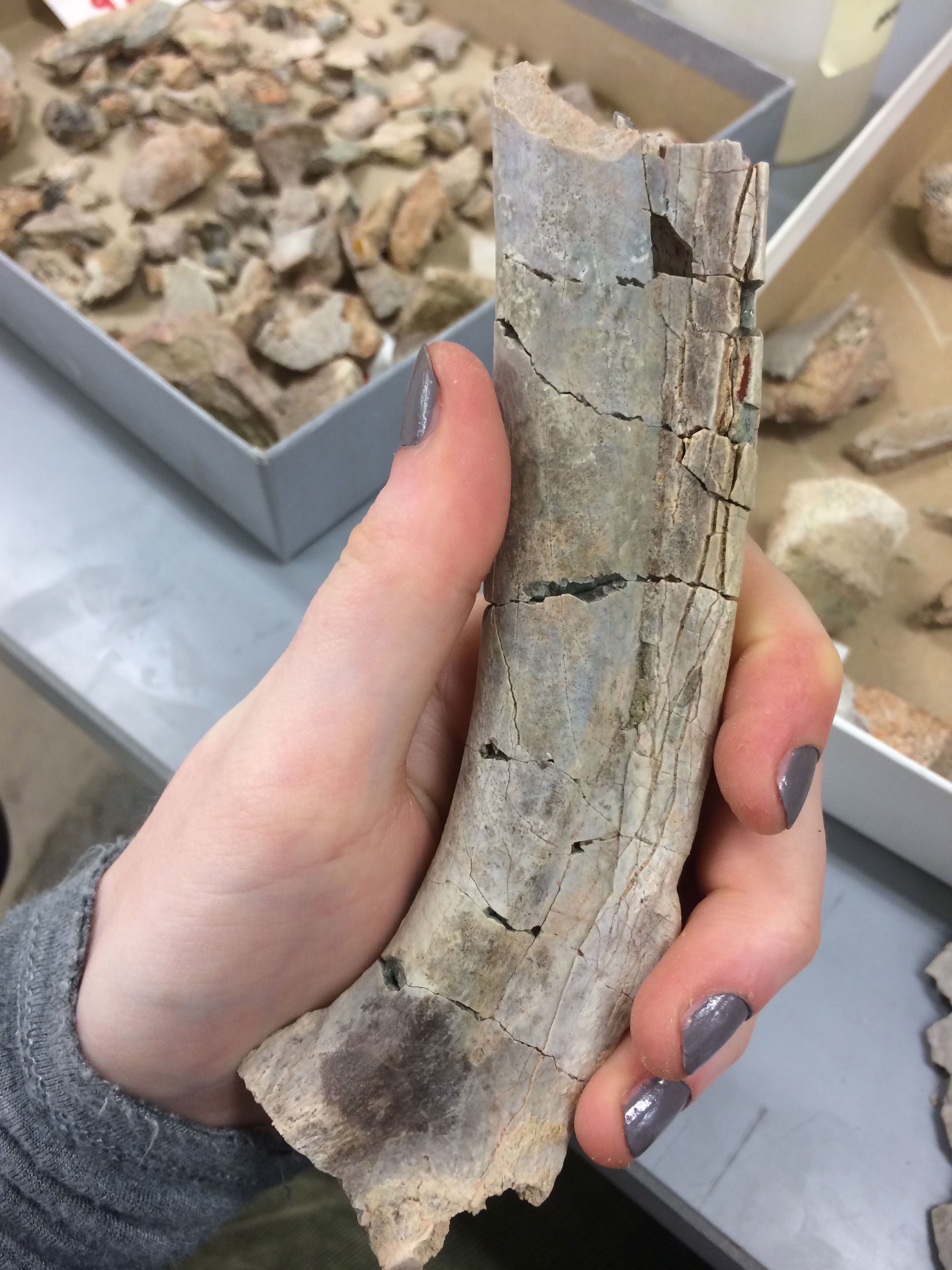
…but I did get to attempt to fix about half of a rib and the lower quarter or so of a femur, which was cool.
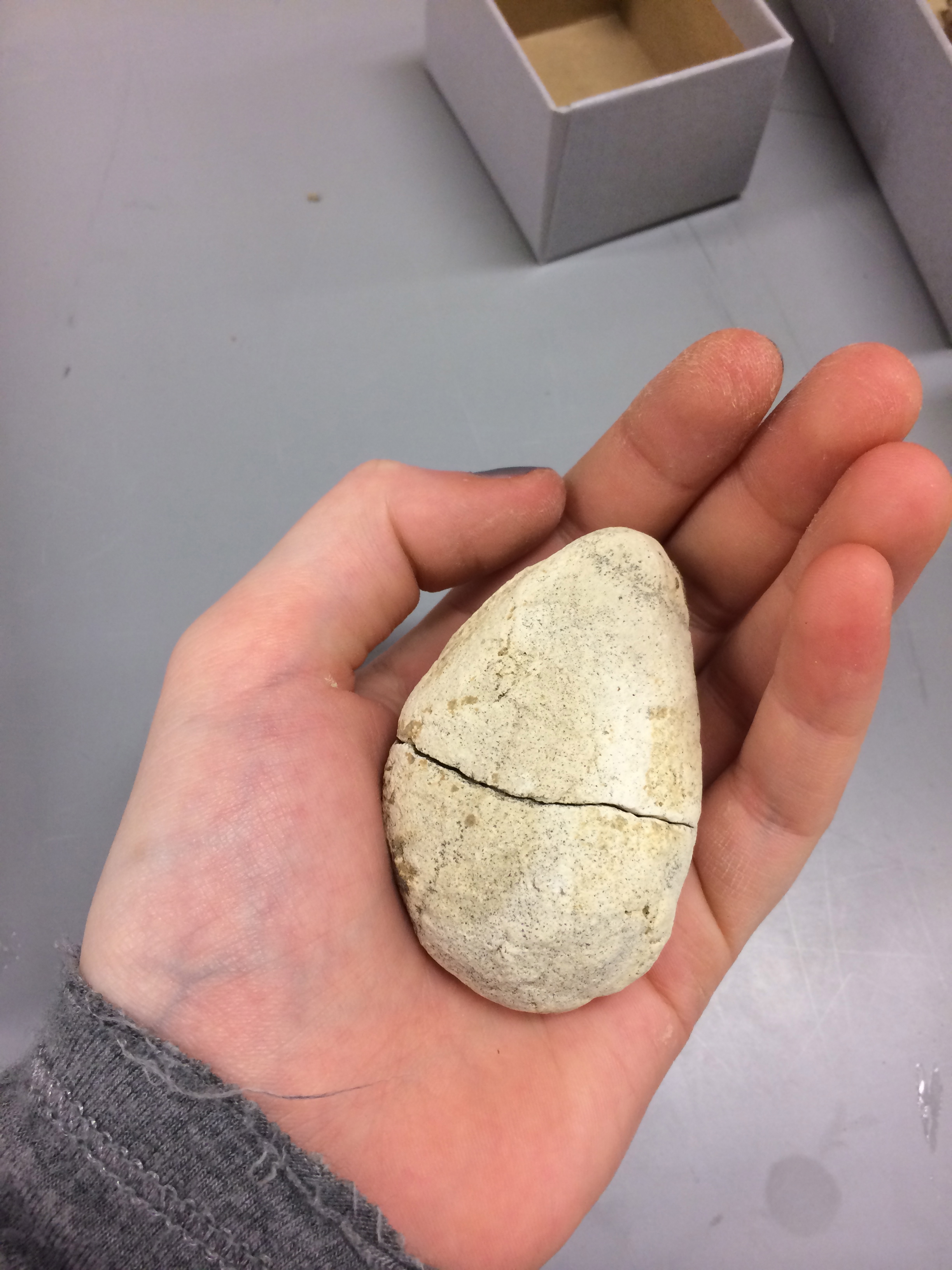
We also found what we thought may have been an egg until my manager informed me that it was a coprolite which added a little, uh, excitement to the morning.
(Coprolite = fossilized poop, for those of you who don’t know. That there? That’s a turd.)
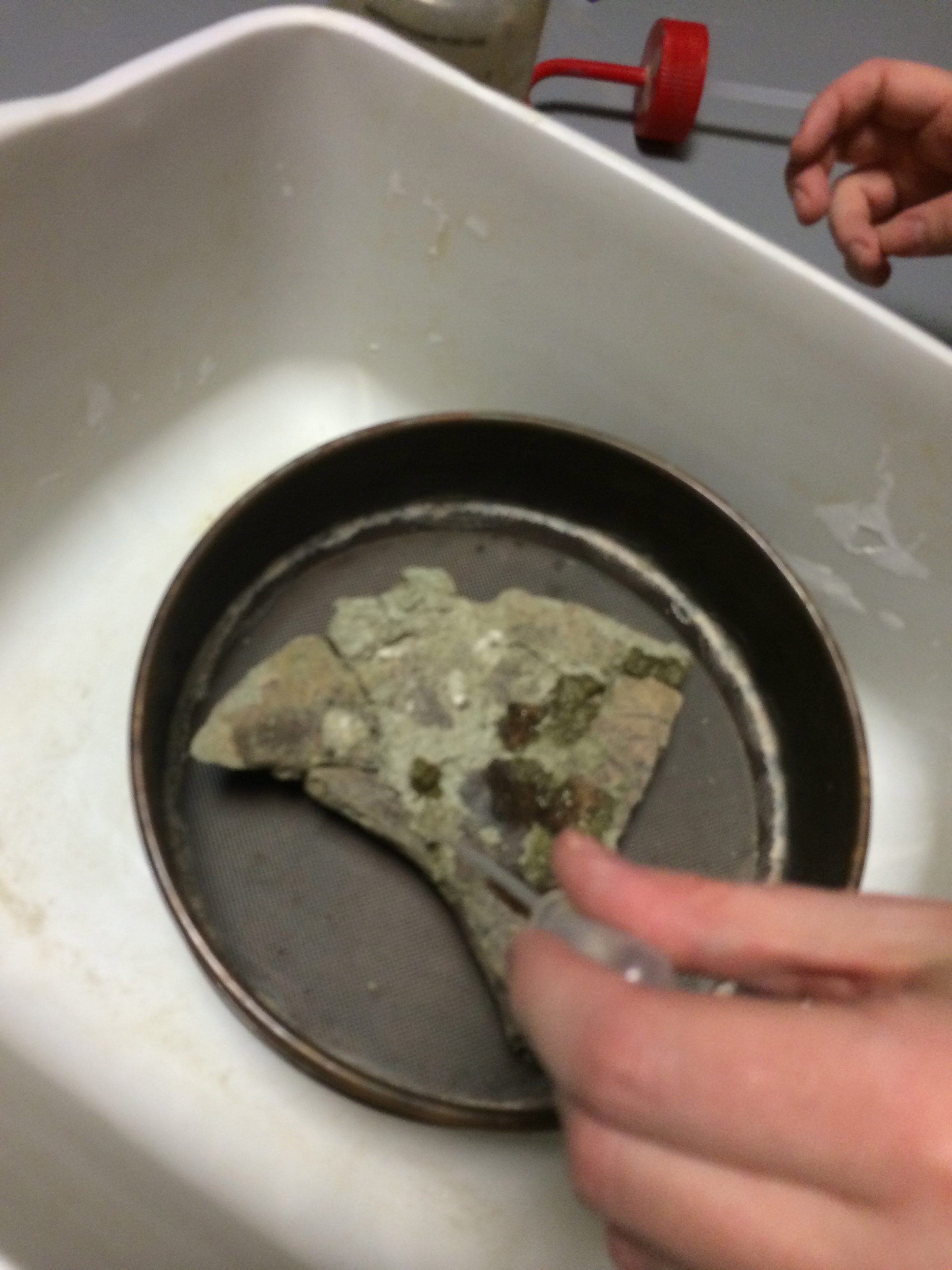
We spent the entire afternoon on Friday and today cleaning this massive pelvis. It hasn’t been identified yet, but my manager seems pretty sure that it’s a brontothere, which is a mammal from the Eocene that looks quite a bit like a modern rhino despite being a much closer relative of a horse. We’ve had a lot of scattered pieces of brontothere teeth, ribs, and even a few reasonably intact leg bones, so it’s definitely a possibility.
I talked about cleaning fossils in my last post, but apparently that sort of cleaning is reserved for the weaker bones. In this case, you wash it as usual in the big industrial sink, but for bigger, sturdier fossils, especially ones that are as caked in mud and sandstone as this one was, that’s only step one. While the matrix around it is still wet, you scrape off everything you can with a dental pick, and then let it dry overnight (or, in this case, over the weekend). Then you squirt it with acetone to dissolve any glue that might have been sprayed on it on-site to keep the fossil in one piece.
(Acetone is really intense and you have to spray it in the industrial sink because it will destroy the paint, the floors, your nail polish, and your soul)
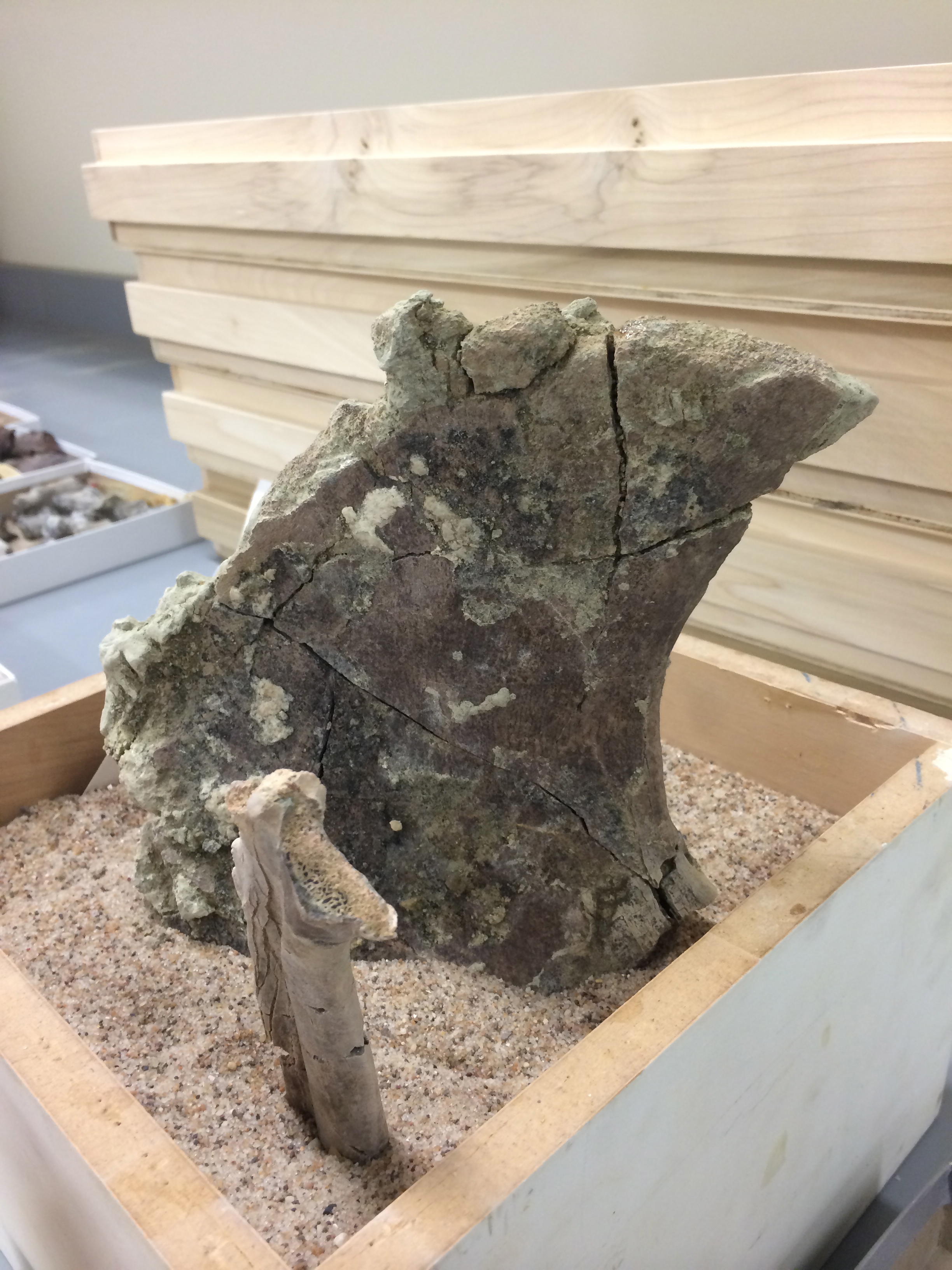
Then you go at it with the dental pick again. Once everything that can be removed has been removed, there’s a chisel and a high-powered hose that you attack it with. We didn’t have to use the hose–since it’s so aggressive, it’s something of a last resort. After it’s at its best state, you rinse it in water, then in acetone again, then in water again. Then it has to sit for an hour or so (time for lunch break) and then we have to glue all the pieces back together that fell apart during cleaning. You end up with something like this:
(That’s the rib in front, for some scale)
Anyway, going into my last week here. The second of the two cousins that I’m staying with just started his spring break, so we’re going to a local ice cream place as a welcome home. Adieu,
What a day. This was our last day of teaching, so Minji decided to do something new and fun for the kids. In other words, we taught them how to play Ultimate Frisbee. It was a blast. Once we had established that you can’t run with the Frisbee, if it falls you have to give it to the other team, and that just chucking it as far as you can isn’t a good strategy, things really got fun. They love throwing the Frisbee, and they caught on well. I played with all three of the classes and am exhausted now. Not only are my feet tired, but the combination of my sweat with all the dust floating around coated my feet in dirt, and there are stripes of white where my flip-flop straps are. It was so bad, the kids kept scolding me to wash my feet!
Afterwards, some of us went for a last stop in Ajumako where it was market day! I know I haven’t talked about the markets so I’ll do that now: it’s certainly an experience. Today, we went with T. Melissa, which definitely makes it more fun. She can speak some Fanti, and whenever we say medasi (thank you) they smile and laugh. She brings a fun, practical attitude and always laughs with the people sitting around in the market. We hopped on the first taxi we saw then waded through the crowds into town when we got out. The market is basically a bunch of wooden scaffolding to separate the stalls (they’re barely even stalls), where wares are generally spread out on the ground or in baskets. My mission: find the cloth, and stay away from the stalls selling fish. (They smell and there are lots of flies. Trust me, you don’t want to eat those fish.) We don’t really bargain, because cloth prices are generally the same. If you want to test your bargaining skills, the best place for that is the touristy craft shops near the beach and slave castle.
I was very successful with my cloth-buying mission. I’m sitting here now, clean, tired, hungry, and happy, but it’s dinner time now and the food is going fast, so I’m signing off for now. Until next time!
The good news: Our fantastic group of 21 has safety returned to their homes after two amazing weeks in the small town of Ollantaytambo, Peru. The bad news: It’s over.
Looking back on the past two weeks is such a whirlwind of happiness, amazement, fresh air, and friendships. The best two weeks of my life flew by and the lessons we learned and people we met will stay with me forever. Because of our “unplugged challenge,” we did not have internet on the trip, so I will be sharing my favorite experiences in chronological order.
A First Glimpse: Day 1
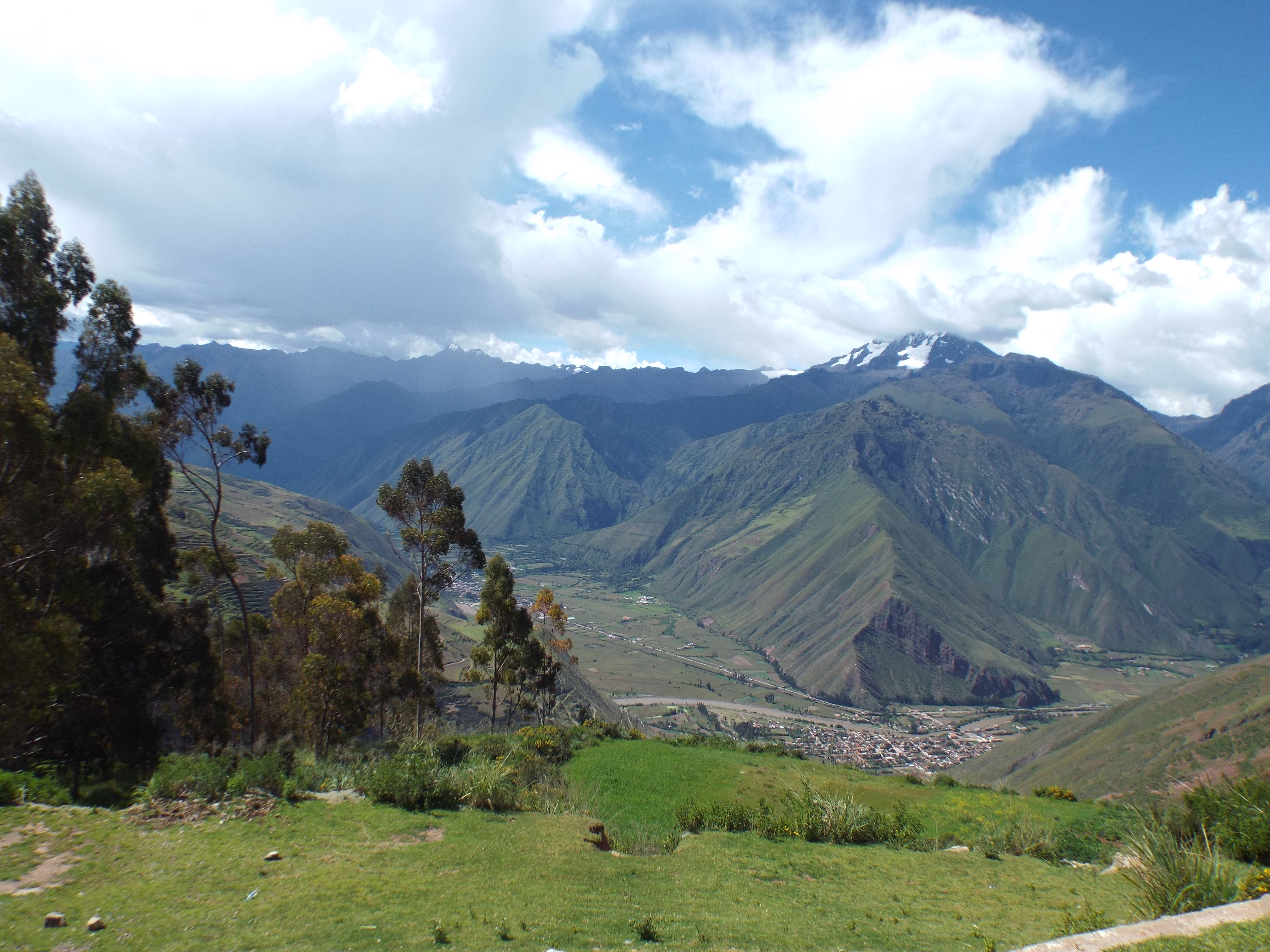
I could see the them the second I jerked awake from my hours of unconsciousness on the plane and I was immediately in complete awe. Mountains were never really on my mind in terms of the things I thought would take my breath away, but as I stared, jaw dropped, I realized that I had never seen a mountain before. My family has never gone skiing, and we usually revert to our little New Jersey beach house that we all love so dearly. But this was something so new, and so incredibly beautiful that I had not expected to be so astonishing. They were everywhere, surrounding me in all directions and at incredible heights. They completely tower over the small towns that reside in their narrow valleys, and seem to rise at a vertical angle out of flat ground. They were monstrous, obstructing the view of the sky, and they were so especially beautiful.
This is a picture I took at a rest stop before we reached the hotel. You can even see the snow peaked mountains in the distance!
Day 2:
We hustled and bustled throughout our new hometown all morning long. Javier and Randall, our two guides, gave us a scavenger hunt that both made us work together, and attempt to navigate the town of Ollantaytambo. As we walked around the town, I loved seeing how people lived, and their everyday wear. Many of the women wore traditional clothing, decorated with countless colors and intricate patterns. I had so much fun wandering the streets, observing and trying to communicate with the towns people. Although I don’t speak Spanish, one of my favorite parts of this day (and throughout the whole trip) was finding ways to communicate with people in other ways besides language. Going into the trip, I knew that the language barrier would be my hardest obstacle and biggest setback, and being put in these situations forced me to learn and grow.
Day 3
My favorite part of the third day was the Despacho Ceremony. We all met in a hostel near our hotel, called the Full Moon Lodge. When we walked in, there was an older looking man sitting on the couch wearing a poncho covered in magnificent colors and designs. He wore a hat too, and had a thick beard. The hostel was beautiful, and there were dream catchers hanging from the ceiling everywhere. We all sat in a circle on the ground around him. He began to speak in detail about our world, and T. Maria translated. He compared the North to an eagle and the South to a condor, explaining that eagles kill and devour their prey without any appreciation, while the condor honors their prey, and fills the land with spirit. He urged us to learn about the Native Americans that live in the north, saying that we are too wrapped up in our material things. At one point he looked at us right in the eye and said, “Look at what you are wearing, you have no memory.” He then pointed to his clothing and said, “Look at what I am wearing, this is my culture.” He told us that if we went and learned our culture, we would then “receive our memory.” Listening to him was very humbling. In that moment I was so glad that I didn’t have my phone or my computer, and that I was taking part in the unplugged challenge. I felt saddened that our society relies so much on our material world, and because of that we are missing a huge part of our culture. He said, “When the day comes that the rich material north collides with the poor spiritual south, that will be the day that we save the world.” It made me think a lot about the unimportance of the things we own, and about the importance of the people we are. After about an hour and a half, he proceeded to lead us through a ceremony, where we each had to wish on coca leaves (a plant that is used for many spiritual and healing purposes), and place them in a pile of things that represent things like good health and happiness. After we each presented out wishes, he blessed it, and then burned the package in the campfire, releasing our wishes into the atmosphere. Many people in the group were moved to tears during the ceremony, and I felt like I walked away having learned an important lesson. Maybe the wishes will even come true. The Despacho Ceremony was a very cool experience, and I am so grateful that I was able to experience it.
This is the picture of the shaman, who was wrapping up our pile of leaves and other natural substances that represented our wishes.




 Westtown Senior Projects' Blog